
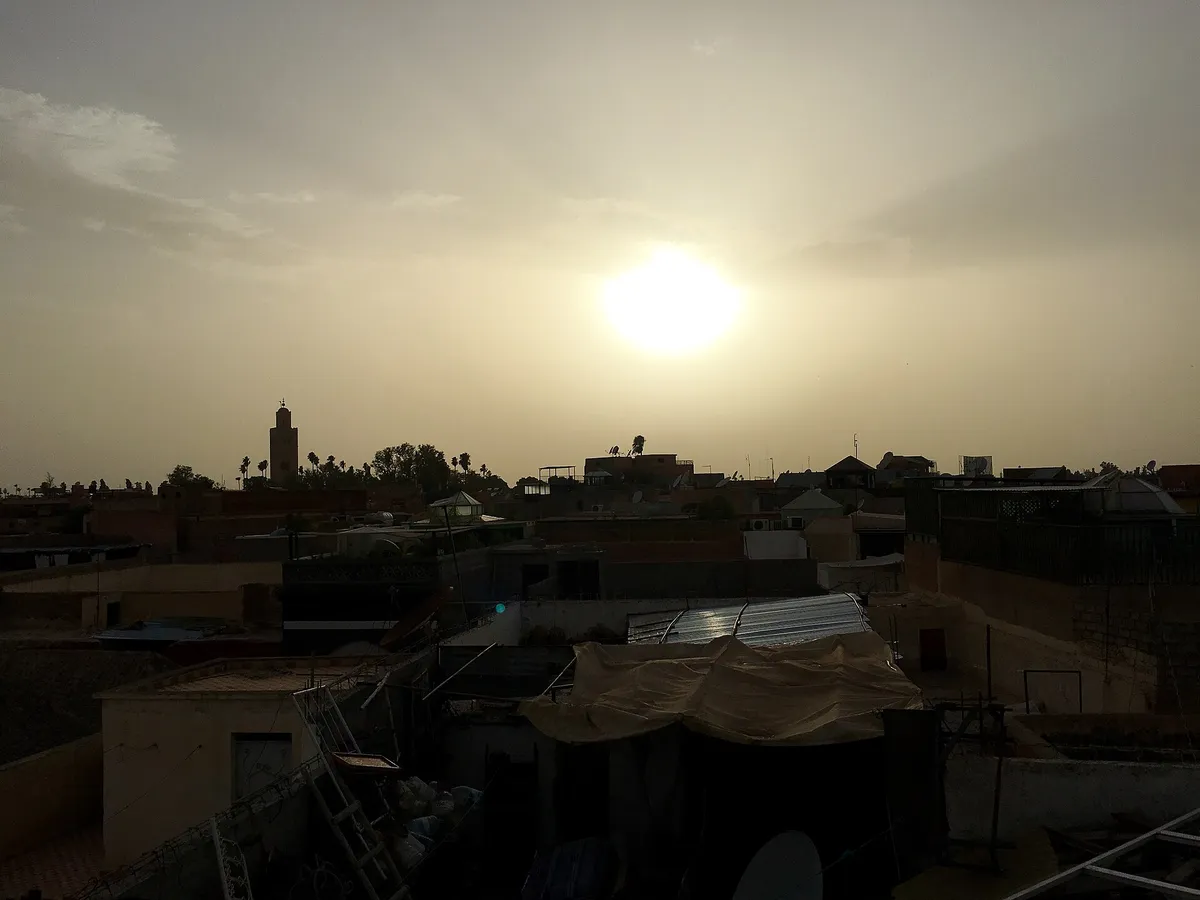
Photo: Thomas Woodtli from Zürich, Switzerland / Wikimedia Commons
Morocco 10-Day Itinerary: Marrakech, Sahara & Fes (2026)
Marrakech's medina souks, Atlas Mountain Berber villages, Sahara desert camel camps, and Fes's ancient tanneries — the complete 10-day Morocco itinerary for 2026.
Overview
Morocco is one of Africa’s most accessible and rewarding travel destinations — a country where you can explore a medieval city unchanged since the 9th century (Fes), sleep in a Saharan desert camp under the Milky Way, walk Atlas Mountain trails through Berber villages, and watch a sunset from a riad rooftop in Marrakech, all within 10 days.
Best season: March–May and September–November Budget: €70–150/day (mid-range); €200–500/day (luxury) Currency: Moroccan Dirham (MAD, approximately 1 EUR = 10 MAD)
Day 1–3: Marrakech
Arrival: Marrakech Menara Airport is served by direct flights from major European cities (Ryanair, easyJet, Air France, British Airways). Pre-book a transfer from the airport (€15–20 fixed taxi rate through the airport taxi stand — avoid freelance drivers).
Day 1 — Djemaa el-Fna and the Souks: The Djemaa el-Fna square (the main square of Marrakech, UNESCO Intangible Cultural Heritage) transforms through the day — fruit stalls and orange juice vendors in the morning, snake charmers and musicians afternoon, food stalls and storytellers at dusk (easily the best time to be in the square). The surrounding souks begin from the north side of the square: the spice market, the leather souk, the metalwork district, the textiles, each in its dedicated quarter extending from the main artery.
Day 2 — Monuments and Palaces:
- Bahia Palace (19th-century grand vizier’s palace, 8 hectares of gardens and decorated rooms — the best preserved Moroccan domestic palace architecture available for public visit)
- El Badi Palace (the ruins of the 16th-century Saadian palace, the storks nesting on the walls, the view over Marrakech from the tower ramparts)
- Saadian Tombs (16th-century royal mausoleum, hidden for centuries under a sealed wall and rediscovered in 1917 — richly carved Moorish ornamentation in the mausoleum chambers)
- Majorelle Garden (the cobalt-blue garden created by French painter Jacques Majorelle, now owned by Yves Saint Laurent — the cactus collection, the Islamic Art Museum, the YSL memorial garden)
Day 3 — Day Trip to the Atlas Mountains: 90 km from Marrakech: the Ourika Valley (the gorge through the Atlas Mountain foothills, traditional Berber villages accessible by short hikes, waterfalls in spring) or the Toubkal National Park (organized trekking from the village of Imlil, full-day hike on the lower slopes of Jebel Toubkal, at 4,167m the highest peak in North Africa).
Day 4–6: Draa Valley and the Sahara Desert
Day 4 — Drive to Zagora through the Draa Valley: The drive from Marrakech over the Tizi n’Tichka pass (2,260m, the highest road pass in the Atlas, 30-minute hairpin ascent with sweeping views over the valleys below) to Ouarzazate (the “Hollywood of Morocco,” where Lawrence of Arabia, Gladiator, and Babel were filmed) and south through the Draa Valley (the date palm oasis corridor of the pre-Saharan south) to Zagora or Mhamid (€150–250 by private driver).
Day 5 — The Sahara Desert: The Erg Chegaga dunes (near Mhamid, less visited than Erg Chebbi near Merzouga, some argue the more authentic Sahara experience) or the Erg Chebbi dunes (near Merzouga, more accessible, more infrastructure) offer the signature Moroccan desert experience:
- Camel trek to the camp at sunset (1.5 hours, the dunes turning orange and ochre as the light fails)
- Desert camp overnight in a luxury or standard tent — dinner by fire, drums and Gnawa music, stars in conditions of absolute darkness far from any city (the Milky Way visible like white smoke across the sky)
- Sunrise from a dune (4 AM alarm, 30-minute climb to the dune crest, the light arriving across the sand sea)
Day 6 — Return North: Drive north through the Ziz Gorge (the most dramatic canyon in Morocco, 20 km of sheer rock walls, the palmery and ksour (traditional fortified villages) below) toward Midelt or Azrou in the Middle Atlas.
Day 7–8: Middle Atlas and Cedar Forest
Day 7 — Azrou and the Barbary Macaques: The Middle Atlas cedar forest at Azrou (160 km south of Fes) is home to the largest remaining wild population of Barbary macaques (the only non-human primates native to Africa north of the Sahara) — the experience of walking among the ancient cedars while the macaques descend from the trees is remarkable. Continue to Meknes or Fes.
Day 8 — Meknes (optional) or Fes: Meknes (the 17th-century imperial capital of Sultan Moulay Ismail, whose construction was powered by 25,000 Christian prisoners and 30,000 horses — the Bab Mansour gate is the most monumental in Morocco; the granaries and stables sprawl over a scale that’s hard to grasp on foot) is 1 hour from Fes.
Volubilis (the best-preserved Roman city in North Africa, 30 km from Meknes, UNESCO World Heritage — the floor mosaics, the triumphal arch of Caracalla, and a setting on a plateau above the Moroccan plain that ranks among the top Roman sites outside Italy and Tunisia).
Day 9–10: Fes
Day 9 — Fes el-Bali: The ancient medina of Fes is the world’s largest medieval city still fully inhabited — 150,000 people in a city plan unchanged since the 9th century. The key sights:
- Chouara Tannery (visible from the rooftop terraces of adjacent leather shops, free if you buy something, CHF 10–20 shop entry otherwise — the enormous stone vats of natural dyes: terracotta, ochre, indigo, poppy, green — make this one of the most visually striking working industrial processes still using ancient methods anywhere in the world)
- Madrasa Bou Inania (14th-century Merinid theological college, a standout example of the zellij (geometric mosaic tile), carved plaster, and carved cedarwood combination that defines Moroccan decorative architecture)
- Al-Qarawiyyin Mosque and University (founded 859 CE, the oldest continuously operating university in the world — not open to non-Muslims, but the glimpse through the gateway and the library courtyard (exterior accessible) is remarkable)
- Fes el-Jdid (the “New Fes,” actually the 13th-century Merinid expansion — the Royal Palace gates, the mellah (Jewish quarter), and the Andalusian quarter)
Day 10 — Departure: Fes-Saïs Airport serves most European capitals directly; alternatively, train to Casablanca Nouzoul (3 hours) for connections or the Mohammed V International Airport.
Logistics
Getting Around Morocco:
- Private driver: The most practical option for long distances (Marrakech–Sahara–Fes circuit) — negotiate €150–250/day with an English-speaking driver
- CTM buses: The national long-distance bus network is reliable and affordable (Marrakech–Fes direct: €20, 9 hours)
- Train: Marrakech–Casablanca (3 hours, €15) and Casablanca–Fes (5 hours, €25) are excellent by Moroccan standards
Best Riads: Book accommodation in the medinas specifically through riads — these courtyard houses provide the only authentic medina experience. Average €80–150/night for mid-range; €200–500 for luxury.
Guided vs. Independent: The souks of Marrakech can be navigated independently; Fes medina benefits from a professional guide for at least the first day. The Chouara Tannery and the key monuments without a guide are accessible but miss the historical context.
FAQ
Is Morocco safe for solo women? Broadly yes, with caveats — harassment from street touts and unsolicited “guides” is more prevalent than in most European destinations, particularly in Marrakech’s Djemaa el-Fna area. Standard approaches (firm polite refusals, staying in well-lit areas at night, booking licensed transportation rather than accepting offers from strangers) are effective. The major medinas are far safer at night than their reputations suggest.
What is the dress code for visiting Morocco? Covering shoulders and knees in the medinas (souks, mosques, religious sites) is expected and respectful. The coastal resort areas (Agadir, Essaouira) are more relaxed. Women covering their hair is not required except inside mosques (where entry may be restricted to Muslims entirely).
When is the worst time to visit Morocco? July–August — extreme heat (35–42°C in Marrakech, 40–45°C in the Sahara), maximum tourist numbers, and the highest accommodation prices. December–January is the other challenging period: cold evenings (10°C in Marrakech), possible Atlas snowfall blocking mountain routes, and some riads without adequate heating.