
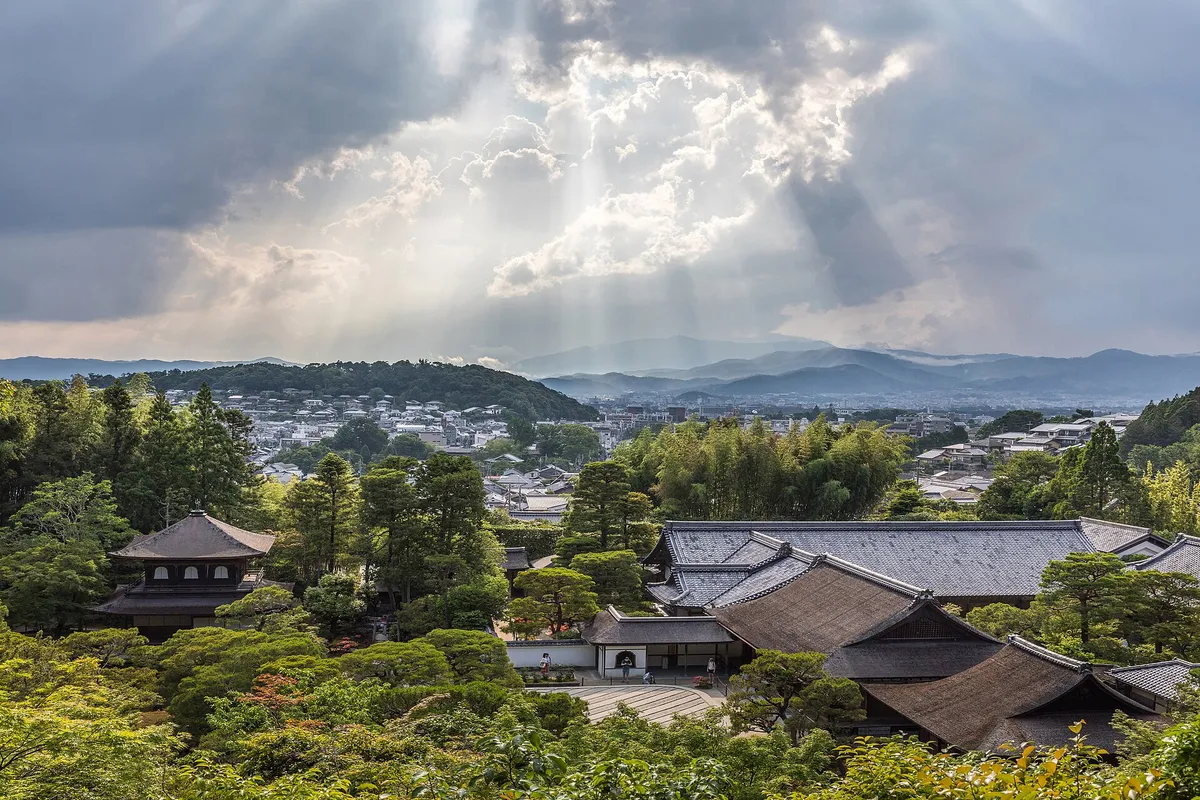
Photo: Basile Morin / Wikimedia Commons
Kyoto 3-Day Itinerary 2026: Fushimi Inari, Arashiyama, Gion & Golden Pavilion
The perfect 3 days in Kyoto — Fushimi Inari's 10,000 torii gates, the Arashiyama bamboo grove, Gion geisha district, Kinkaku-ji Golden Pavilion, and the Philosopher's Path — the complete Kyoto itinerary for 2026.
Kyoto 3-Day Itinerary 2026
Kyoto was Japan’s imperial capital for over 1,000 years (794–1868 AD) and contains 17 UNESCO World Heritage Sites — more per square kilometer than anywhere else on earth. Three days allows serious engagement with the most significant sites without rushing; a week allows the deeper exploration of sub-temples, hidden gardens, and the seasonal changes that make Kyoto one of the few cities worth returning to in every season.
Key principle: The most-visited sites (Fushimi Inari, Arashiyama bamboo grove, Kinkaku-ji, Arashiyama) receive the majority of visitors between 10am and 4pm. Arrive before 8am (most sites open at 7–9am) or after 4pm. The early morning experience of Fushimi Inari at 6am — or Arashiyama at 7am — is one of the most transformative travel experiences in Asia.
Day 1: Fushimi Inari and Gion
Morning: Fushimi Inari Taisha
Address: 68 Fukakusa Yabunouchicho, Fushimi Ward, Kyoto (10 minutes by JR Nara Line from Kyoto Station — the shortest JR trip in Japan)
The site: The shrine complex and mountain behind it contain approximately 10,000 torii gates (orange vermilion wooden gates, donated by businesses and individuals as prayers; each gate is inscribed with the donor’s name and date on the back) forming a series of tunnels that ascend Mt. Inari (233m).
How to structure the visit:
- 7am arrival: The lowest gates (the iconic “thousand torii,” Senbon Torii) are empty of visitors; the light through the gates in the low morning sun is extraordinary
- Full circuit (Mt. Inari summit and return, approximately 4km): 2–2.5 hours; the trail forks repeatedly, with rest houses at the major intersections (Yotsutsuji, 1h from base)
- Partial circuit (to Yotsutsuji, the halfway point with a panoramic view over Kyoto): 45 minutes each way; the most common approach for visitors without time for the full circuit
The inari foxes (kitsune): White fox statues throughout the shrine are messengers of Inari, the kami of rice, agriculture, foxes, and industry. The offerings include fried tofu (abura-age, the favorite food of foxes in Japanese mythology).
Afternoon: Nishiki Market and Gion
Nishiki Market (“Kyoto’s Kitchen”): The covered market street (5 blocks, 400m) running east-west through central Kyoto. 130 stalls selling Kyoto vegetables (kyo-yasai), tofu (17 varieties, including sesame tofu and freeze-dried tofu), pickles (tsukemono, the signature of Kyoto cuisine), fish, fresh mochi, and the street food that defines Kyoto eating.
The essential Nishiki foods:
- Takenoko (bamboo shoots, March–May): The most prized Kyoto vegetable; grilled on a skewer at several stalls
- Dashimaki tamago (rolled egg with dashi broth): A Kyoto style that differs from Tokyo’s by being lighter, with more dashi
- Yatsuhashi: Kyoto’s most famous sweet — folded triangles of cinnamon-flavored rice flour, filled with red bean paste (the unbaked version, namagashi, is the more delicate form)
Gion (evening): The most historically preserved geisha district in Japan — Hanamikoji Street (the main cobblestone street, lined with ochaya teahouse facades) and the Shirakawa canal (stone bridges, weeping willows, traditional machiya townhouses).
Geiko and Maiko: Gion is home to approximately 80 geiko (the Kyoto word for geisha; the apprentice geisha are called maiko) — the highest concentration of professional geisha in Japan. Encounters along Hanamikoji between 6–8pm are possible but increasingly rare as maiko take taxis to avoid the crowds.
Dinner in Gion: Kyoto cuisine (kaiseki, the multi-course formal dining tradition) is the most refined in Japan. Budget kaiseki (7–9 courses, approximately ¥8,000–12,000 per person) at Gion Nanba or Yoshikawa; the most accessible introduction to the form.
Day 2: Arashiyama and Temples
Morning: Arashiyama Bamboo Grove
Access: Hankyu Arashiyama Line (from Kawaramachi) or Sagano Line (from Kyoto Station); 20–30 minutes.
The bamboo grove: 500m through the world’s most famous bamboo forest. The bamboo (moso bamboo, Phyllostachys edulis) grows 20m tall; the sound it makes in the wind — a deep, low rustling — is listed by the Japanese Ministry of the Environment among the 100 Sounds of Japan.
7am arrival strategy: The bamboo grove is genuinely transformative before 8am — the light is diffuse, the crowd is absent, and the sound of the bamboo is audible. By 10am, it’s a tourist conveyor belt.
Tenryu-ji Temple (adjacent to the bamboo entrance): One of the five great Zen temples of Kyoto — the garden (designed by Musō Soseki, 1344) is a masterpiece of shakkei (borrowed scenery) composition, with the Arashiyama mountain range framed in the garden views.
Monkey Park Iwatayama (behind Arashiyama): 170 Japanese macaques (nihon-zaru) at a viewpoint 160m above the Hozu River — one of the most accessible wild monkey encounters in Japan.
Arashiyama Boat Rental: Rowboats on the Ōi River beneath Togetsukyō Bridge (the Moon-Crossing Bridge, 1606 style) — the mountain scenery reflected in the river is some of the finest landscape in Kyoto.
Afternoon: Ryoan-ji and Kinkaku-ji
Ryoan-ji Temple (the most famous rock garden in the world): 15 stones arranged in white raked gravel — the karesansui (dry landscape garden, 1499). The composition is constructed so that one stone is always hidden, regardless of viewing angle; the garden has been interpreted as islands in an ocean, as tiger cubs crossing a river, as a mind emptied of concepts.
Best moment: Early morning (the temple opens at 8am), when the reflection of the garden in the polished floor of the veranda creates a mirror image below the stones.
Kinkaku-ji (the Golden Pavilion): The top two floors of the three-story Zen garden pavilion are coated in gold leaf — reflected in the Mirror Pond (Kyōko-chi) below. The original was burned by a mentally ill monk in 1950 (the incident that inspired Yukio Mishima’s 1956 novel The Temple of the Golden Pavilion); the current structure is a 1955 reconstruction, entirely clad in gold.
Important: This is the most visited site in Kyoto — approximately 3 million visitors annually. Arrive at opening (9am) or accept crowds. The golden reflection in the pond in early morning light is the image worth waiting for.
Day 3: Philosopher’s Path and Fushimi Inari (Evening Return)
Morning: The Philosopher’s Path
The route (2km, north–south along a canal, connecting Nanzen-ji to Ginkaku-ji): Named for the Kyoto University philosopher Nishida Kitaro, who reportedly meditated while walking this path daily. Cherry trees (approximately 450) line the canal.
Cherry blossom season (late March–early April): The most beautiful time to walk the Philosopher’s Path — the trees bloom and the petals fall into the canal water. The walk becomes extraordinary; book accommodation 3–4 months ahead.
Nanzen-ji Temple (the starting point, southern end): The largest Zen temple complex in Japan; the sanmon gate (1628) is climbed to the second level for views over Kyoto. The aqueduct (Meiji-era brick, 1890) running through the temple precinct — an industrial structure in the middle of a medieval Zen garden — is one of the most unexpected juxtapositions in Kyoto.
Ginkaku-ji (the Silver Pavilion, northern end): Built as a counterpart to the Golden Pavilion but never coated in silver (the owner, Ashikaga Yoshimasa, died before completion). The cone of raked white sand (Kogetsudai, “Moon-Viewing Platform”) in the garden achieves its composition only in raking moonlight.
Afternoon: Nijo Castle and Kyoto Imperial Palace
Nijo Castle (Nijojo-cho, Nakagyo): The shogun Tokugawa Ieyasu’s Kyoto palace (1603) — the most complete surviving example of shiro castle architecture in Japan. The famous nightingale floors (uguisubari): deliberately constructed to squeak under any footstep, the floors in the palace corridors are one of the most extraordinary architectural security systems in history — the squeaking would warn of any assassin’s approach.
Kyoto Imperial Palace (Kyoto Gyoen National Garden): The imperial residence from 794 to 1869. The grounds are free and open to the public; the palace buildings require advance reservation (free) through the Imperial Household Agency.
Evening: Kiyomizu-dera
Kiyomizu-dera Temple (east Kyoto, above the Higashiyama hills): The 3m × 4m wooden main stage (the butai, “wooden stage”) extending over the hillside on 139 wooden pillars (no nails used) and offering views over the valley and central Kyoto — the single most cinematically powerful view from any temple in Japan.
Evening visit: The temple is illuminated at night (until 9:30pm) during certain seasons; the evening light on the wooden stage with the city lights below is extraordinary. Check illumination dates in advance.
Essential Kyoto Experiences
Kaiseki dinner (the full experience): Budget ¥15,000–30,000 per person for the 10–12-course winter kaiseki at a traditional Gion restaurant. The first encounter with kaiseki is one of the most significant meals of a lifetime — a seasonal ingredient-driven sequence that defines what Japanese hospitality means at its most refined.
Macha: Kyoto’s Uji region (30 minutes south by train) produces the finest matcha in Japan. The preparation and consumption of matcha in a traditional tea house (chashitsu) with a Japanese garden view is an experience specific to Kyoto; Ippodo Tea (near Kyoto Imperial Palace) has the finest retail selection.
Tofu cuisine (shojin ryori, Buddhist vegetarian): Kyoto’s temples produced the most refined vegetarian cuisine in Japan. Tousuiro (Gion) and temple restaurant meals (Tenryu-ji serves shojin ryori in the garden) are the best introductions.
FAQ
Is Kyoto worth visiting without a JR Pass? Yes — local Kyoto bus and subway cover the major sites. The JR Sagano Line (Arashiyama) and JR Nara Line (Fushimi Inari) are efficient and inexpensive point-to-point. A JR Pass is worth it only if you’re traveling to other JR Shinkansen cities.
Should I base myself in Kyoto or Osaka? Kyoto, if the budget allows. Kyoto accommodation is more expensive than Osaka but staying in Kyoto allows early-morning visits to Fushimi Inari and Arashiyama. Commuting from Osaka (Shinkansen, 15 minutes; regular train, 30 minutes) works but costs 2 hours per day.
How many days does Kyoto need? Minimum 3; ideally 5–6 to include day trips to Nara (the deer park and Todai-ji temple) and Uji (Byodo-in temple and matcha). Kyoto rewards slowness — the difference between a 3-day and 7-day visit is the transition from sightseeing to understanding.