
Photo: Diliff / Wikimedia Commons
Prague Travel Guide: Castles, Beer, and Baroque Splendor
A complete guide to visiting Prague — from Prague Castle and Charles Bridge to Czech beer culture, the Jewish Quarter, and essential day trips to Český Krumlov.
Prague is one of Europe’s most intact medieval cities — a place where Gothic towers, Baroque palaces, and Art Nouveau facades stand shoulder to shoulder as if time paused somewhere around 1900. It’s also one of the continent’s most popular destinations, which means timing and neighborhood choice matter enormously for the quality of your visit.
Prague Castle
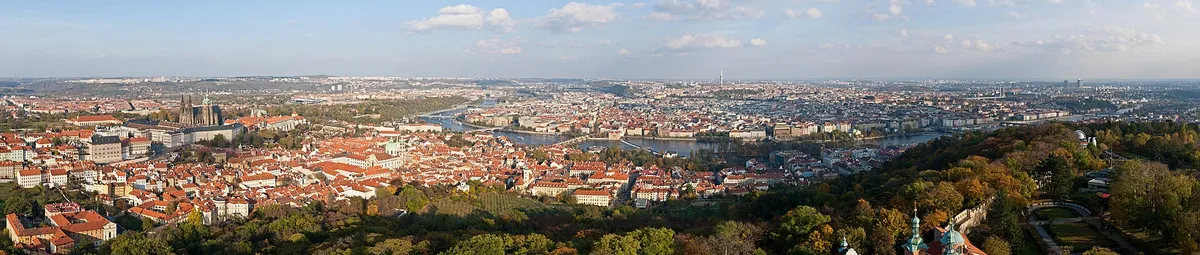
The largest ancient castle complex in the world by area, Prague Castle (Pražský Hrad) dominates the city’s skyline from its perch above the Vltava River. Inside the castle grounds you’ll find St. Vitus Cathedral (with its stunning stained-glass windows by Alfons Mucha), the Old Royal Palace, St. George’s Basilica, and the famous Golden Lane — a row of tiny colorful houses that once housed castle guards and later Franz Kafka (who briefly lived at No. 22).
Buy the Circuit B ticket (covers the cathedral, Old Royal Palace, and Golden Lane) for the best value. Go early — the castle opens at 6:00 AM for the grounds, and mornings are significantly less crowded. The view over Prague from the castle ramparts is worth the entire visit on its own.
Charles Bridge
Karluv Most, built in 1357, connects the Old Town to the Lesser Town (Malá Strana) across the Vltava. Its 30 Baroque statues of saints — including the famous St. John of Nepomuk — line both sides. The bridge is atmospheric at any hour, but it gets genuinely unpleasant with tourists in mid-morning and afternoon during summer.
Cross at dawn or after 9 PM to experience it at something approaching its proper grandeur. Photographers particularly love the pre-sunrise mist and the amber glow of the bridge lamps at night.
Old Town Square and the Astronomical Clock
Staroměstské náměstí (Old Town Square) is Prague’s main showpiece: Gothic churches, pastel-colored Baroque buildings, the Jan Hus Memorial, and above all, the Orloj — the medieval astronomical clock on the Old Town Hall tower. Every hour from 9 AM to 11 PM, the clock performs its mechanical procession of apostles. The show takes about 45 seconds. People crowd the square to watch it; the actual show is charming but modest.
Climb the Old Town Hall Tower for the best overhead view of the square and the rooftops beyond.
The Jewish Quarter (Josefov)
A few minutes’ walk from Old Town Square, Josefov is one of the best-preserved historic Jewish quarters in Europe. Six synagogues (including the 13th-century Old-New Synagogue, the oldest active synagogue in Europe), the Old Jewish Cemetery (where gravestones are layered 12 deep due to limited burial space), and the Jewish Museum make this a compact but profoundly moving district to explore.
The Jewish Museum ticket covers most of Josefov and costs around CZK 500 (€20). Allow at least two hours.
Vinohrady: Where Locals Live
Once you’ve ticked off the major sights, explore Vinohrady — a residential neighborhood southeast of Wenceslas Square with tree-lined streets, fin-de-siècle apartment buildings, excellent coffee shops, independent bookstores, and local restaurants where you’ll share tables with Czech residents rather than tour groups. The farmers’ market at Náměstí Míru on Saturdays is excellent.
Nearby Žižkov is scruffier but has some of the city’s best bars and an enormous (and fascinating) Communist-era monument — the Žižkov Television Tower, which you can climb for panoramic views.
Czech Beer Culture
Czech beer is not just a drink here; it’s a cultural institution. The Czech Republic has the highest beer consumption per capita in the world, and Czech lager — brewed using the Pilsner method developed in nearby Plzeň in 1842 — remains the global benchmark.
Go to a traditional pivnice (beer hall) or hospoda (pub) rather than a tourist bar on the Old Town Square. Prices in local pubs are dramatically lower (CZK 40–60 per half-liter vs CZK 120–200 in tourist spots). Look for Pilsner Urquell, Kozel, Bernard, and Únětické Pivo on tap. The proper pour — slowly tilted glass, three pulls, dense foam head — is taken seriously.
Lokál (with multiple Prague locations) is a modern take on the traditional beer hall and exceptionally well-run.
Day Trips from Prague
Český Krumlov (3 hours by bus or train) is a UNESCO World Heritage town wrapped by a loop of the Vltava River, dominated by a massive castle and virtually unchanged since the 18th century. It’s one of Central Europe’s most beautiful small towns. Go on a weekday and stay overnight if possible — day-tripping crowds can overwhelm it in summer.
Kutná Hora (1 hour by train) offers two remarkable attractions: the Sedlec Ossuary (the Bone Church, where the bones of 40,000 people form chandeliers and decorations) and the magnificent St. Barbara’s Cathedral, a Gothic masterpiece. A half-day is sufficient.
Best Time to Visit Prague
April to May and September to October are the ideal windows. Weather is pleasant (15–22°C), the city is vibrant but not overwhelmed, and you can enjoy outdoor terraces without fighting humidity. Spring brings blooming chestnut trees; autumn brings warm light and fewer queues.
June to August is peak summer: hot, extremely crowded, and significantly more expensive. The Old Town becomes almost unwalkable at midday. If you must travel in summer, book accommodation months in advance and focus on early mornings and evenings.
November to February is cold (sometimes below freezing) but atmospheric. The Christmas markets (late November to early January) are genuinely lovely, and the crowds drop dramatically outside the holiday period.
Accommodation by District
- Old Town (Staré Město): Central and convenient but most expensive; expect tourist-heavy streets at all hours.
- New Town (Nové Město): More local feel around Wenceslas Square, good transport links, slightly lower prices.
- Malá Strana (Lesser Town): Romantic but quiet at night; great location below Prague Castle.
- Vinohrady: Local neighborhood, excellent restaurants and cafes, 10 minutes by Metro from Old Town.
- Žižkov: Cheapest options, more authentic atmosphere, slightly further from main sights.
Budget Overview
Prague is no longer the bargain it once was, but it remains affordable by Western European standards:
- Budget: €35–55/day (hostel, pub meals, local transport)
- Mid-range: €80–130/day (private hotel room, restaurant dinners, museum entries)
- Luxury: €200+/day (boutique hotels, fine dining, private tours)
The Czech koruna (CZK) is the currency — not the euro. Exchange at a bank or ATM; avoid exchange booths offering “no commission” (their rates are typically worse).
Prague rewards those who walk its streets slowly, slip into a church when it’s quiet, and find a pivnice to nurse a beer while watching the evening crowd. The sights are magnificent, but the atmosphere is the real attraction.