
Photo: Diliff / Wikimedia Commons
Eastern Europe Itinerary: Prague, Vienna, Budapest & Kraków (12 Days)
Prague's Josefov and Malá Strana castles, Vienna's imperial Ringstrasse, Budapest's thermal baths and Ruin Bars, and Kraków's Wawel Cathedral — the 12-day Central European grand tour.
The Central European Grand Tour
Prague, Vienna, Budapest, and Kraków form one of the richest cultural itineraries in Europe — four capitals of the Habsburg-era Central European world (Vienna the center; Prague, Budapest, and Kraków the regional capitals), each with its own architecture, history, and food and café culture. The route is geographically efficient (a clockwise or counter-clockwise loop from any of the four cities, connected by excellent rail), affordable (all four cities are significantly cheaper than Paris, Amsterdam, or London), and genuinely different from the standard Western European tour.
Day 1–3: Prague
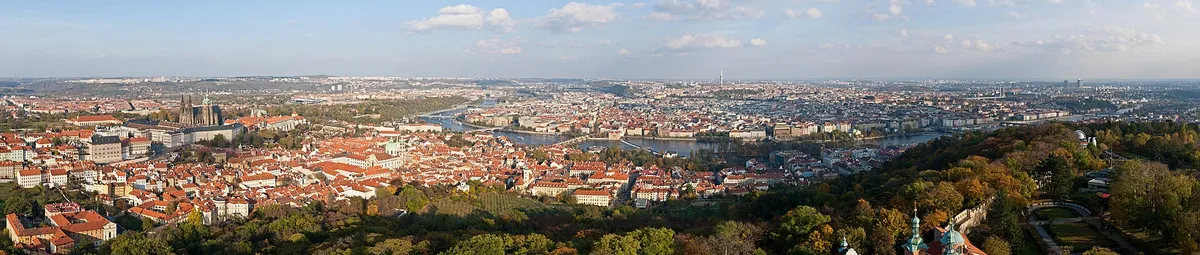
Prague is one of the most beautiful cities in Central Europe — its Gothic and Baroque center (one of the least damaged Central European cities of WWII, so the Old Town Square, the Jewish Quarter, and Prague Castle are all intact), the Charles Bridge (the 14th-century stone bridge with 30 Baroque sculptures, among the most photographed bridges in Central Europe after Venice’s Rialto), and a deep-rooted beer culture (the Czech Republic has the highest per-capita beer consumption in the world; Pilsner Urquell from Plzeň is the original Czech lager and the reference beer for the global lager category) define the city.
Essential Prague experiences:
- Prague Castle complex: The largest ancient castle in the world (70,000 m²) — St. Vitus Cathedral (a Gothic masterpiece with a striking rose window), Golden Lane (the tiny 16th-century cottages built into the castle walls, where Franz Kafka lived briefly in No. 22), and views over the red-tiled roofs of Malá Strana from the castle terraces
- Josefov (Jewish Quarter): Six historic synagogues (including the 13th-century Old-New Synagogue, the oldest continuously operating synagogue in Europe), the Old Jewish Cemetery (12 burial layers, tombstones overlapping in dense clusters — 12,000 tombstones above ground representing 100,000 burials), and the Jewish Museum
- Old Town Square: The Astronomical Clock (the Orloj — the 15th-century mechanical clock with an animated procession of the 12 Apostles every hour), Týn Church (Gothic spires forming one of the most dramatic church façades in Bohemia), and the Old Town Hall
- Malá Strana: The Baroque quarter below the Castle — the Church of St. Nicholas (one of the finest Baroque churches in Bohemia), Wallenstein Garden (a formal garden with free admission), and the café culture along Nerudova street
Accommodation in Prague:
- The Augustine (a 13th-century Augustine monastery conversion and one of the top hotels in Prague, €200–800/night)
- Hotel Josef (an excellent design hotel in Josefov, €100–300/night)
- Mosaic House (a well-regarded boutique hostel and hotel, strong value, from €30 dorm / €80–150 private)
Day 4–6: Vienna
Train from Prague to Vienna: 4–4.5 hours (RegioJet or ÖBB — the Austrian national railway, the most comfortable option). The train journey passes through the Bohemian and Moravian countryside.
(See our separate Where to Stay in Vienna guide for the full neighborhood breakdown.)
The essential Vienna experiences:
- Kunsthistorisches Museum: One of the finest art history collections in Central Europe — a major Titian collection (the Danae, the Marsyas, and other late works), the world’s most complete collection of Pieter Bruegel the Elder’s work (the Hunters in the Snow, Children’s Games), and the Kunstkammer
- The Vienna State Opera: The second oldest continuously operating opera house in the world — book a standing ticket (€5–10, available 80 minutes before the performance at the opera house box office) for the rare chance to hear Vienna Philharmonic-conducted opera standing in the orchestral section
- Schönbrunn Palace: The Habsburg summer palace (1,440 rooms, the most visited tourist attraction in Austria) and its formal garden (the Gloriette, the Neptunbrunnen, and the Privy Garden)
- The Naschmarkt: The 1.5km open market — see the Where to Stay guide for detail
Day 7–9: Budapest
Train from Vienna to Budapest: 2.5–3 hours (EuroCity or Railjet — the Austrian ÖBB high-speed service). The train journey passes through the Hungarian lowlands.
Budapest is two cities — Buda (the castle district and the hills, on the right bank of the Danube) and Pest (the flat, grid-plan commercial and cultural city, on the left bank) — connected by the Chain Bridge (1849, the first permanent bridge across the Danube and the engineering feat that unified the two cities).
Essential Budapest experiences:
- The Hungarian Parliament Building: Arguably the most beautiful building in Budapest (a Neo-Gothic structure on the Pest Danube bank, 268 meters long and the largest parliament building in Europe, with a gold dome, ornate turrets, and near-perfect symmetry), accessible by guided tour (book in advance)
- Fisherman’s Bastion (Halászbástya): A Neo-Romanesque terrace above the Danube on Buda Castle hill, offering the best view in Budapest (the Parliament, the Chain Bridge, and the Danube visible from its turrets). Free access
- The Great Synagogue of Budapest: The largest synagogue in Europe (3,000 seats) and one of the most important pieces of Jewish architectural heritage in Central Europe after Prague’s Josefov
- Széchenyi Thermal Bath: The most famous of Budapest’s public baths (outdoor thermal pools, Neo-Baroque architecture dating to 1913) — the city’s bathing culture (built on 118 thermal springs, with 40 public baths) is one of its most distinctive features, and Széchenyi is the most accessible and the largest
- Ruin Bars: Budapest’s converted ruin bar culture (Szimpla Kert — the original, open since 2002 in a former factory; Instant; Fogás; and the wider bar scene of the 7th District)
Day 10–12: Kraków
Train from Budapest to Kraków: 7–8 hours via Bratislava and Katowice, or via EuroCity to Katowice then regional. The journey can also be broken in Bratislava (a compact Slovak capital and the only capital city bordering two different countries — Austria and Hungary — with its own castle and Old Town worth a half-day stopover).
Kraków is one of the most beautifully preserved medieval cities in Eastern Europe — the Main Market Square (the Rynek Główny, the largest medieval market square in Europe at 200m × 200m, with the Cloth Hall and St. Mary’s Basilica, home to the Wit Stwosz altarpiece, widely regarded as one of the greatest Gothic altarpieces in the world at 12 meters tall with 600 carved figures), Wawel Castle and Cathedral (the royal residence of the Polish kings, where Polish royalty was crowned and buried from 966 to 1795), and the region’s most significant Holocaust memorial site.
Auschwitz-Birkenau: The Auschwitz-Birkenau concentration camp (70 km west of Kraków — day trip by bus, shuttle, or organized tour) is the most significant Holocaust memorial site in the world — 1.1 million people murdered here, primarily Jewish. The visit is one of the most important and one of the most difficult experiences available to a traveler. Book timed-entry tickets in advance (free but required); guided tours are recommended.
Kazimierz: Kraków’s historic Jewish quarter (the neighborhood where Schindler’s List was partly filmed) — layered Jewish heritage (the 16th-century Remuh Synagogue and Cemetery, the Galicia Jewish Museum), a lively contemporary café and restaurant scene, and a growing concentration of art galleries.
Practical Information
Rail passes: A Eurail Global Pass (or the regional Central Europe Pass) covers all four trains in this itinerary. Book seat reservations in advance for the Vienna–Budapest EuroCity and the Budapest–Kraków services. The Czech RegioJet (Prague–Vienna) is excellent quality and allows booking 60 days ahead.
Budget: This itinerary is one of the most affordable in Europe — hotel costs, restaurant costs, and activity costs are all significantly below Western European equivalents. Budget travelers: €60–100/day; mid-range travelers: €120–200/day; luxury: €250+/day.
FAQ
Which city is the highlight of this itinerary? Each city has a different primary strength: Prague for its intact medieval core; Vienna for imperial grandeur and museum culture; Budapest for thermal baths and the most dynamic city atmosphere; Kraków for its striking main square and the most profound day trip (Auschwitz). Most travelers who complete the circuit cite Prague as the most visually beautiful and Budapest as the most enjoyable to spend time in.
Is 3 days enough for Vienna? The minimum — the Kunsthistorisches Museum, the Vienna State Opera, and the Naschmarkt can be done in 3 days, but Schönbrunn Palace, the Belvedere (home to the Klimt collection at the Oberes Belvedere — the Kiss and the Judith are here), and the Wiener Werkstätte design heritage require at least 2 additional days. Vienna rewards a longer stay.
How to get from Prague to Vienna to Budapest without flying? RegioJet (Prague→Vienna, 4h30, €20–40 booked ahead) then EuroCity (Vienna→Budapest, 2h30, €30–60). Total: one day of travel covering 900km, with both trains extremely comfortable.