
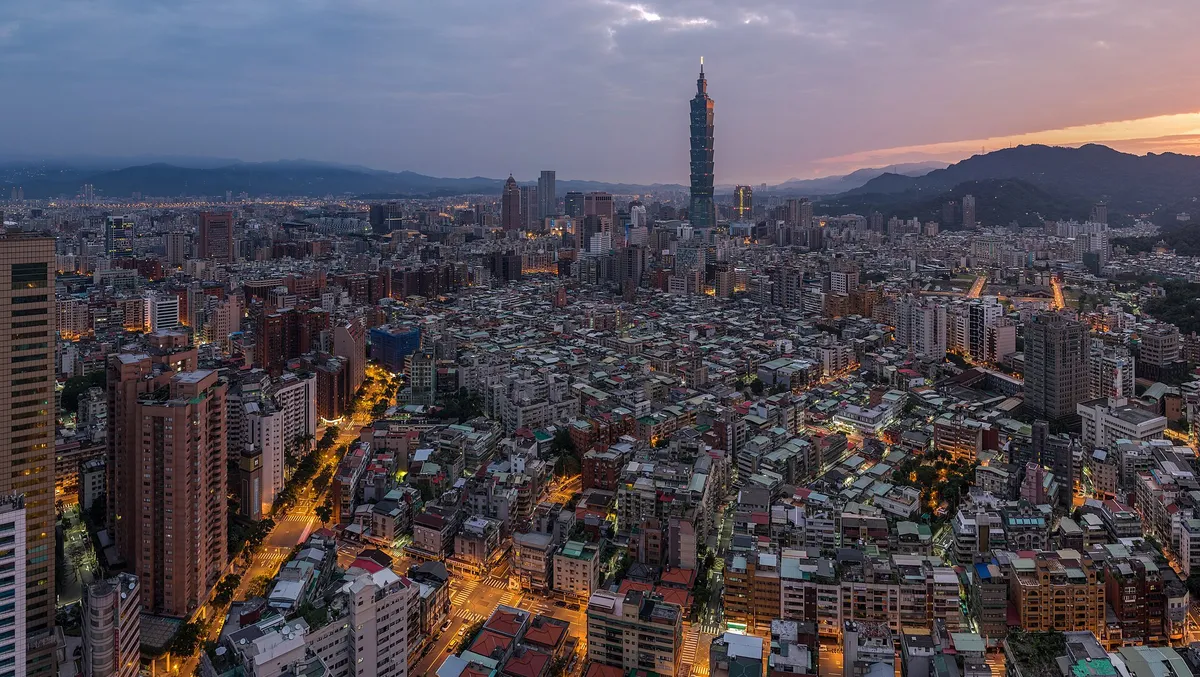
Photo: Chensiyuan, edit by DXR / Wikimedia Commons
Best Hotels in Taiwan: Taipei, Sun Moon Lake & Taroko Gorge (2026)
The Mandarin Oriental Taipei's Dunhua North boulevard, The Lalu Sun Moon Lake's aboriginal heritage resort, and Silks Place Taroko's marble-walled canyon hotel — Taiwan's best hotels beyond Taipei 101 in 2026.
Taiwan: Asia’s Most Underrated Hotel Destination
Taiwan tends to fly under the radar compared to its neighbors, which is part of its appeal. Its night markets anchor the country’s street food culture — Shilin Night Market, spread across 15-plus streets of stalls, is the best-known, famous above all for oyster omelette (ô-á-tsian), made with an egg-and-sweet-potato-starch batter, fresh oysters (Crassostrea gigas), and sweet chili sauce. Bubble tea, meanwhile, traces back to Chun Shui Tang in Taichung, where zhen zhu nai cha (pearl milk tea) was invented in 1986 and has since gone on to sell an estimated 2.4 billion cups a year worldwide.
The island’s nature is just as distinctive: Taroko National Park centers on Taroko Gorge, an 800-meter-deep marble canyon carved by the Liwu River through the Central Mountain Range, traversed by a 19-kilometer highway that remains one of the most technically demanding road-building feats in Taiwan’s history. Culturally, the National Palace Museum houses roughly 700,000 pieces of Chinese imperial art, evacuated from Beijing’s Forbidden City by the Nationalist government in 1948–1949 in one of the most significant cultural relocations of the 20th century — its star attraction is the Jadeite Cabbage, an 18.7cm Qing dynasty carving. And Taiwan’s hot springs (wenquan) are concentrated around Beitou, known for its radium-rich water, a spring chemistry considered unusual even by regional standards, with therapeutic claims dating to the Japanese colonial period.
Taipei — The Arts and Food Capital
Mandarin Oriental Taipei — Dunhua North Boulevard
Price: TWD 12,000–80,000/night (~$370–2,470) | Location: 158 Dunhua North Road, Songshan
Mandarin Oriental Taipei sits on Dunhua North Road, arguably Taipei’s most elegant boulevard, lined with ginkgo trees — among the oldest tree species on Earth, with an evolutionary lineage stretching back some 270 million years, and a striking sight when their leaves turn gold each October and November. The hotel’s dining lineup includes Bencotto (Italian, known for its pasta and truffle dishes), Ya Ge (a Cantonese restaurant serving some of the best dim sum at any Taipei hotel, including har gow prawn dumplings folded with the traditional minimum of seven pleats), and The Cake, its in-house patisserie.
Palais de Chine Taipei — Art Deco Ambassador Heritage
Price: TWD 8,000–50,000/night (~$250–1,550) | Location: 3 Chengde Road, Datong, Taipei
Palais de Chine is one of Taipei’s most culturally immersive hotels, built around a collection of more than 500 artworks spanning Chinese calligraphy (shu fa, a tradition stretching back over 2,000 years), contemporary Taiwanese art, and Chinese imperial artifacts. It sits in the historic Datong District, near Dihua Street, Taiwan’s best-preserved traditional trading street, still lined with dried goods sellers, Chinese herbal medicine shops, and fabric merchants. The hotel’s Chinese restaurant is known for its Taiwanese lu rou fan (braised pork rice), a slow-braised pork belly dish considered one of the country’s essential comfort foods.
Sun Moon Lake — Taiwan’s Mountain Lake
The Lalu Sun Moon Lake — Aboriginal Heritage Resort
Price: TWD 12,000–60,000/night (~$370–1,860) | Location: 142 Zhongxing Road, Yuchi Township, Nantou
The Lalu sits on Sun Moon Lake, Taiwan’s most important body of water, a reservoir at 748 meters altitude in Nantou County and home to the Formosan blue magpie (Urocissa caerulea), the national bird, known for its cobalt-blue tail. The lake is also the traditional home of the Thao people, Taiwan’s smallest indigenous group with only about 700 remaining members, whose religious tradition centers on a sacred oracle stone at the lake’s center and whose fishing methods still draw on traditional techniques. The 33-kilometer Sun Moon Lake cycling path, including a dedicated cyclists-only section, is one of the most popular cycling routes in Taiwan, and sunset over the lake — with the silhouette of Lalu Island in the foreground — is among its most photographed sights. The nearby Wen Wu Temple, a Confucian-Taoist complex, offers one of the widest lake views from its terrace.
Taroko Gorge — Marble Canyon
Silks Place Taroko — Canyon Wall Hotel
Price: TWD 8,000–35,000/night (~$250–1,080) | Location: 18 Tianxiang Road, Xiulin Township, Hualien
Silks Place Taroko sits at Tianxiang, the deepest point of Taroko Gorge reachable by road, with marble walls rising 300 meters directly from the hotel terrace and the sound of the Liwu River rushing below — one of the more dramatic natural settings for a hotel anywhere in East Asia. Nearby, Xiangde Temple, a Buddhist temple built into the cliffside, is one of the most dramatically positioned religious buildings in Taiwan, while the Zhuilu Old Trail — a demanding cliff path 700 meters above the river, originally used by the indigenous Taroko (Truku) people — offers the gorge’s most challenging hike.
FAQ
What is the best Taiwan itinerary for 7 days? Days 1–3: Taipei — the night markets (Shilin and Raohe), the National Palace Museum (allow at least three hours to see the Jadeite Cabbage and the Meat-shaped Stone), and Jiufen Old Street, the foggy, lantern-lit mountain teahouse village often cited as a partial visual inspiration for Hayao Miyazaki’s Spirited Away (2001). Days 4–5: Taroko Gorge and Hualien. Days 6–7: Sun Moon Lake, returning to Taipei.
Is Taiwan good for vegetarians? Yes. Buddhist vegetarian cooking (su) has deep roots here — Taiwan has one of the highest numbers of vegetarian restaurants per capita in East Asia, reflecting a Buddhist population of roughly 15 million, or about 28% of the country, one of the highest proportions of any East Asian democracy. Temple-affiliated restaurants, including those run by the Tzu Chi Buddhist organization, are known for some of the most convincing mock-meat cooking anywhere, built on gluten-based seitan, tofu, and mushroom substitutes.