
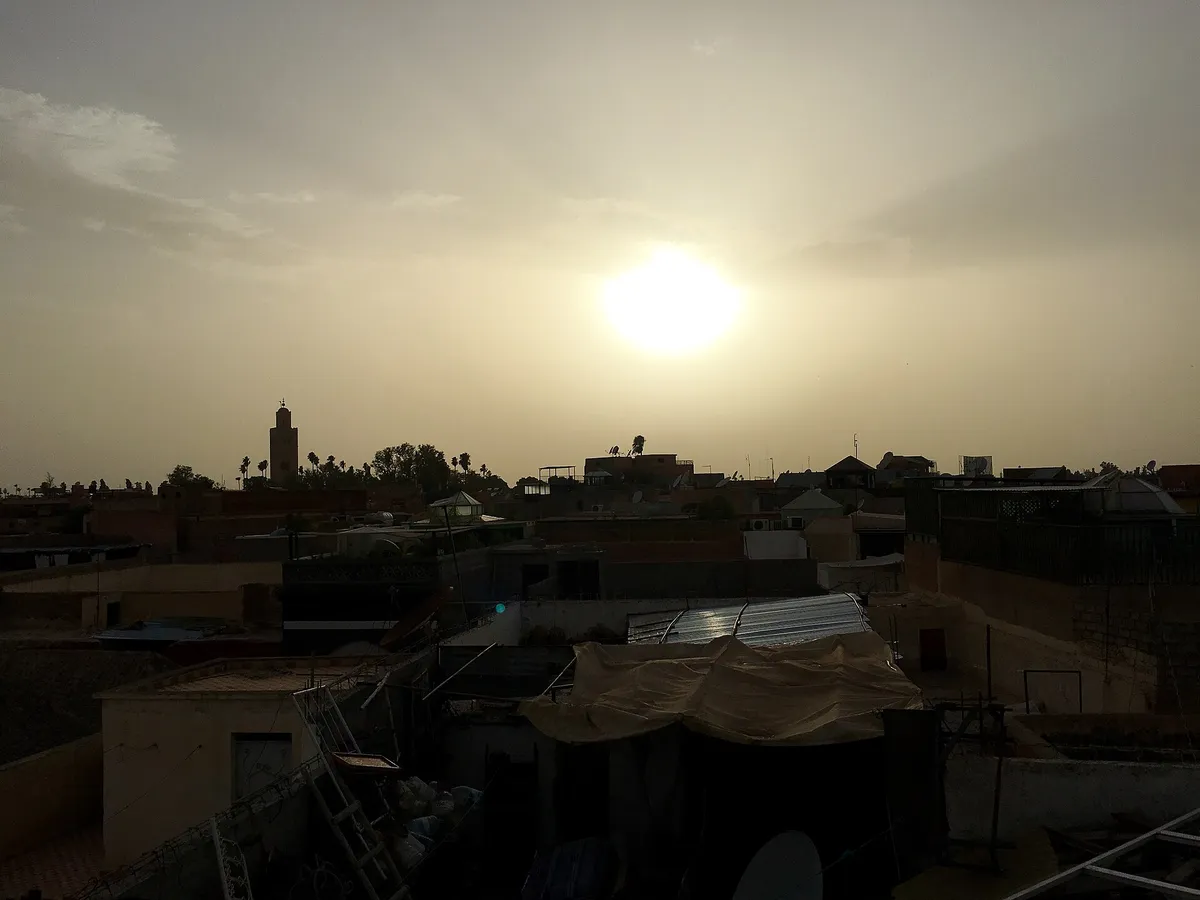
Photo: Thomas Woodtli from Zürich, Switzerland / Wikimedia Commons
Best Hotels in Marrakech: Riads, Palaces & Desert Retreats (2026)
La Mamounia's Winston Churchill legacy, Amanjena's rose-colored pools, and well-regarded riads in the Medina — Marrakech's best hotels from luxury palaces to atmospheric guesthouses in 2026.
Marrakech’s Hotel Types
Marrakech has three distinct hotel formats, each providing a completely different experience:
The Grand Palaces (La Mamounia, Royal Mansour, Es Saadi): The large 5-star properties outside or at the edge of the Medina, with extensive gardens, multiple pools, and full resort infrastructure.
The Riads (the traditional courtyard houses of the Medina): The defining Marrakech accommodation — an internal courtyard with a fountain, a plunge pool, a roof terrace, 4–12 rooms, and extremely personal service. The best riads offer the most intimate connection to the Medina experience of any accommodation type.
The Palmeraie Resorts (the palm grove area northeast of the Medina): Larger resort properties set in the ancient Palmeraie — further from the Medina on foot, but with more space and a stronger outdoor focus.
The Grand Palaces
La Mamounia — The Benchmark
Price: €400–5,000/night | Location: Avenue Bab Jdid, adjacent to the Medina
La Mamounia (1923) is arguably the best hotel in Africa. The 1986 renovation by Jacques Garcia added the painted ceilings, tadelakt plasterwork, and cedar mashrabiya screens that define its Art Deco interiors, and its 8-hectare garden actually predates the hotel by 150 years — the olive trees were planted by Sultan Moulay Mamoun in the 18th century. The pool is the largest of any hotel in Marrakech. Winston Churchill stayed here almost every year from 1935 onward, calling it “the most lovely spot in the world”; the Churchill Bar is named for him. La Grande Table Marocaine serves some of the best traditional Moroccan cooking found in any hotel anywhere.
Royal Mansour Marrakech — The King’s Private Hotel
Price: €1,000–10,000/night | Location: Rue Abou Abbas El Sebti, New City
Royal Mansour Marrakech was built by King Mohammed VI in 2010 as his personal gift to the world, and it shows: the hotel is a self-contained medina of 53 riads, each its own private three-floor maison with 4–6 rooms, a plunge pool, a hammam, and full butler service, all linked by an underground service corridor that keeps the alleyways above entirely private and quiet. Moroccan craftsmen skilled in zellij tilework, tadelakt plastering, and carved cedar woodwork spent three years building it. It’s the most expensive hotel in Africa, and arguably the most singular at any price.
Es Saadi Palace — Palmerie Glamour
Price: €250–2,000/night | Location: Rue Ibrahim El Massoudi, Hivernage
Es Saadi Palace sits on one of the most impressive garden estates in Marrakech — 7 hectares including Majorelle-blue pools, an old rose garden, and the Jad Mahal cabaret, one of Morocco’s best entertainment venues. The Palace Suites (the original 1952 building) and the Garden Villas offer distinct experiences within the same grounds.
The Finest Riads
Riad Kheirredine — Medina Perfection
Price: €250–1,200/night | Location: Derb Kheirredine, Mouassine neighborhood
Riad Kheirredine is one of the most celebrated boutique riads in Marrakech, with 19th-century architecture that includes a double courtyard, an Andalusian fountain, and a painted cedar ceiling in the grand salon. With only 6 rooms, it’s one of the most intimate riads in the Medina, and the roof terrace looks out across the Medina to the Koutoubia Minaret and, in winter, the snow-capped Atlas Mountains.
Riad Jardin Secret — Mouassine Grandeur
Price: €300–2,000/night | Location: Rue Mouassine, Mouassine neighborhood
Housed in a former 16th-century palais, this is a standout riad in the Mouassine neighborhood — actually two riads (private and “exotic”) connected by a passageway, with a 17-meter outdoor pool and a genuinely rare feature: the large private “secret garden” referenced in its name, tucked inside the Medina walls. It has 14 rooms and suites in total.
Dar Darma — Creative Medina
Price: €150–600/night | Location: Derb Snane, central Medina
Dar Darma is among the best small riads in the Medina, functioning almost as a curated gallery of Moroccan contemporary art and craft. It has a beautiful plunge pool and the kind of personal service that comes naturally to an 8-room property.
Palmeraie Resorts
Amanjena — Rose Pavilions
Price: €900–6,000/night | Location: Route de Ouarzazate, Palmeraie
Amanjena was the first Aman property in Africa and remains its best. Rose-colored pavilions (mazot) and plunge pools (bassin) are arranged around a central pool that mirrors the sky and the surrounding Moroccan architecture. Its restaurant serves Moroccan and French cuisine, and cycling routes run through the olive groves and Palmeraie — arguably the most peaceful luxury experience Marrakech offers.
Beldi Country Club — Palmeraie Character
Price: €200–800/night | Location: Km 6 Route du Barrage, Palmeraie
Beldi Country Club is the most atmospheric of the Palmeraie properties at accessible prices — a 7-hectare organic rose garden (the roses go into its rose water and rose oil products), two pools (indoor and outdoor), and a design approach that was genuinely countercultural when it opened: Beldi was using traditional Marrakchi crafts in a contemporary style before that became the norm.
Understanding Marrakech’s Geography
The Medina (Old City): The UNESCO World Heritage walled city — the Jemaa el-Fnaa square, the souks, the Medersa Ben Youssef (the 14th-century Islamic college, one of the finest pieces of Moroccan architectural heritage open to non-Muslim visitors), and the Yves Saint Laurent memorial Jardin Majorelle, the cobalt-blue garden commissioned by painter Jacques Majorelle in the 1920s and later preserved and opened to the public by Saint Laurent and Pierre Bergé in 1980.
Gueliz (New City): The French Protectorate colonial city west of the Medina — wider streets, outdoor café culture, the Galerie 127 photography gallery, and the most practical supermarkets and pharmacies. Most of the large 5-star hotels sit in the area between Gueliz and the Medina, known as Hivernage.
The Palmeraie: The ancient palm grove (20,000 palm trees, farmed since the 11th century) northeast of the Medina — home to the large resort hotels, the golf courses, and the most spacious properties in the region.
FAQ
What is the best time to visit Marrakech? March–May and October–November bring comfortable temperatures (20–28°C), snow-capped Atlas Mountains as a backdrop, and souks that are still pleasant to walk in the heat of the day. June–August climb to 38–42°C, making midday walking in the Medina genuinely uncomfortable. December–February brings cool evenings (8–15°C) with warm, sunny days (18–22°C) — a good window if combining Marrakech with an Atlas Mountains trek.
What is a riad and is it better than a hotel? A riad (from the Arabic riyadh, meaning garden) is a traditional Moroccan courtyard house: the exterior faces inward toward a central courtyard rather than out to the street, which gives it both privacy and a cooler microclimate in summer. A good riad offers more atmosphere than most hotels can match, with highly personal service across just 4–12 rooms. For an authentic Marrakech stay, a quality riad is the right call; for resort amenities like a large pool, multiple restaurants, or a spa, the grand palaces are the better fit.
Is it safe to explore the Medina independently? Yes, with the usual precautions. Daytime walking is safe; pickpocketing is most concentrated around the Jemaa el-Fnaa square, so keep cameras secured and bags closed. Evenings are fine too, though the lanes get genuinely harder to navigate after dark. The unofficial guides who approach visitors outside the Koutoubia Mosque are persistent but not aggressive — a firm “la shukran” (“no thank you”) is generally enough, and they’ll accept it.