
Photo: Basile Morin / Wikimedia Commons
Where to Stay in Busan: Best Neighborhoods & Hotels
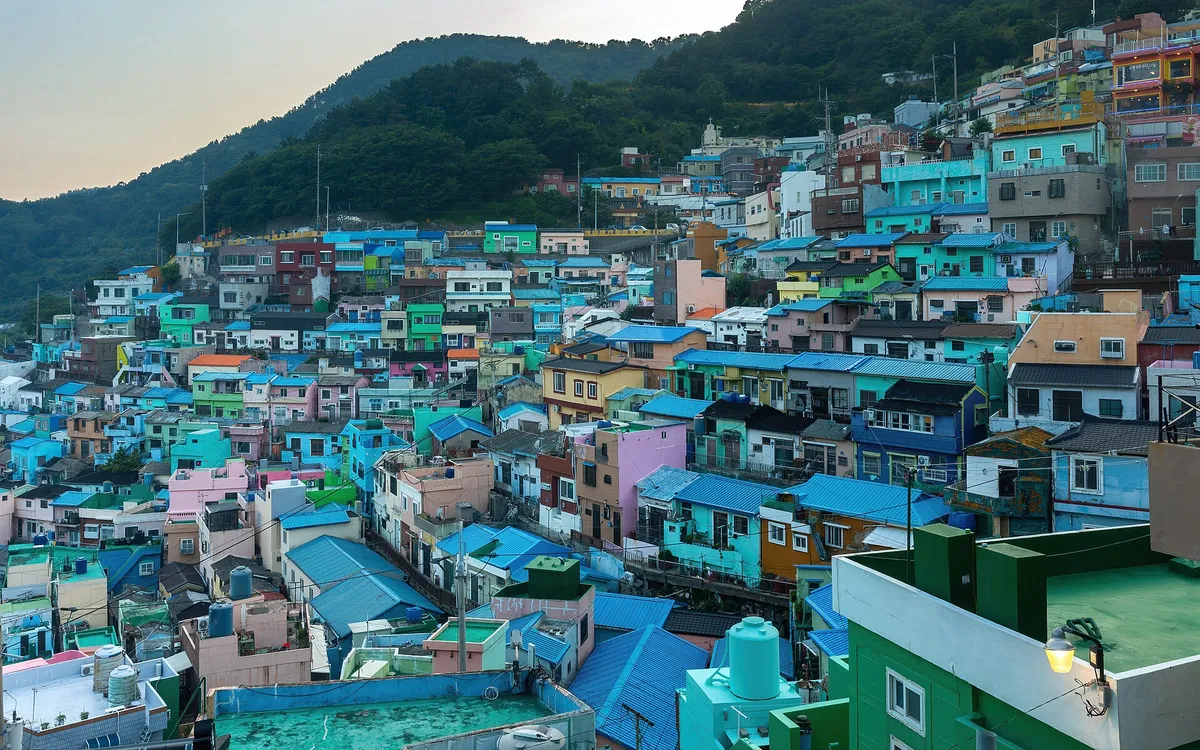
Haeundae beach or Gamcheon village? The best areas and hotels in Busan, South Korea — from luxury beachfront to budget-friendly guesthouses.
Busan is South Korea’s second city and its greatest contrast to Seoul. Where the capital offers gridlocked expressways, glass towers, and the relentless pace of a global megacity, Busan opens with a bay full of fishing boats, mountains that tumble directly into the sea, and a temperament shaped more by the waterfront than the boardroom. This is a city where you can watch the pre-dawn auction at Jagalchi fish market, hike to a clifftop temple at Haedong Yonggungsa, and spend the afternoon on one of Korea’s finest beaches — all within reasonable transit distance of each other. The seafood alone justifies the visit: raw flatfish at a market pojangmacha stall, steaming bowls of dwaeji gukbap from a backstreet pork broth specialist, or grilled eel on the Gwangalli waterfront as the suspension bridge lights come on after dark.
Whether you are arriving from Seoul for a long weekend, crossing from Fukuoka on the morning hydrofoil, or building Busan as a standalone destination, HaveNaGo has mapped out exactly where to stay for every travel style and budget. The choice of neighborhood shapes the entire texture of your visit — Haeundae and Seomyeon offer two very different versions of Busan, and knowing the difference before you book saves considerable frustration.
TL;DR
- Best beach address: Park Hyatt Busan or Westin Josun — both on Haeundae, both genuinely excellent
- Best for budget travelers: Nampo-dong guesthouses €30–60/night, close to markets and the historic port
- Best transport hub: Seomyeon — central subway connections to every neighborhood in the city
- Best for atmosphere: Gwangalli Beach area — hip independent cafes, the bridge light show, and a more local feel than the Haeundae resort strip
Busan Neighborhoods at a Glance
| Area | Best For | Avg Price | Vibe |
|---|---|---|---|
| Haeundae | Beach, luxury, resort | €150–350/night | Cosmopolitan, resort-tower energy |
| Seomyeon / City Center | Central access, nightlife | €60–130/night | Busy, commercial, excellent transport |
| Nampo-dong / Jagalchi | Markets, traditional Busan | €30–80/night | Authentic, local, historic port area |
| Gwangalli | Hip cafes, bridge views | €50–120/night | Relaxed, photogenic, younger crowd |
| Gamcheon | Art village, backpacker scene | €30–60/night | Bohemian, hillside village atmosphere |
Haeundae Beach
Korea’s most famous beach strip runs for 1.5 kilometres of white sand backed by a wall of luxury resort towers. In summer it packs to capacity; outside July and August it becomes one of those rare resort districts that actually rewards off-season visits, with empty sands, reasonable hotel rates, and the full drama of sea and mountains without the crowds. The infrastructure here — restaurants, beach facilities, shopping, late-night entertainment — is geared entirely toward the visitor, which means that everything is effortlessly accessible and nothing is particularly cheap.
Park Hyatt Busan (€200–350/night) occupies a striking glass tower at the eastern end of Haeundae, and its design — with guest rooms oriented to face both the ocean and Dalmaji mountain simultaneously — is genuinely impressive. The rooftop pool, the open-kitchen restaurant, and the quality of finishings throughout make this one of the best hotel properties in Korea, not merely in Busan. Views from upper floors are extraordinary: the entire sweep of the bay, the container port to the west, and the mountain-backed skyline of the city stretching south. If budget allows for one splurge night in Busan, this is the property to choose.
Westin Josun Busan (€180–300/night) occupies the prime mid-beach position that its sister property in Seoul occupies relative to Gyeongbokgung — history, brand, and location combined in one package. The Josun name has been synonymous with Korean luxury hospitality for over a century, and the Busan property delivers on that heritage with consistent service, a large outdoor pool positioned right at sand level, and rooms that manage to feel warmer and more residential than most five-star beach hotels. The breakfast spread is among Busan’s best hotel offerings. This is the choice for couples seeking a classic beach resort experience with strong service credentials.
Both Haeundae hotels are within walking distance of the BEXCO convention center, Dongbaek Island, and the Busan Aquarium, making them practical as well as beautiful.
Seomyeon
Seomyeon is Busan’s commercial and transport heartland — the intersection of metro Lines 1 and 2 means that every corner of the city is accessible from here without changing trains. The neighborhood runs through an underground shopping arcade that stretches for nearly a kilometre beneath the streets, surfacing into department stores, a dense nightlife district, and the kind of urban energy that Seoul travelers will find familiar. It is not Busan’s most picturesque area, but it is almost certainly its most practical as a base.
La Valse Hotel (€80–130/night) brings genuine boutique sensibility to an otherwise functional district. The interiors draw on a music-and-arts theme — named for Ravel’s La Valse — with real care, and the service standard consistently outperforms what the price point would suggest. For budget-to-mid travelers who prioritize transport links and central access above atmosphere, the broader Seomyeon area offers numerous business hotels and modern city hotels running €60–100/night that deliver clean, well-equipped rooms without unnecessary frills. These make excellent bases for travelers planning full-day excursions to Gamcheon, Haedong Yonggungsa temple, and Gyeongju.
Nampo-dong and Jagalchi Market
This is old Busan — the neighborhood that shaped the city’s identity as a fishing port and that served as a refugee haven during the Korean War. Jagalchi market is Korea’s largest seafood market, and the experience of walking its covered aisles at dawn while vendors haul live octopus, heaped flatfish, and sea cucumbers onto ice-banked display is not easily forgotten. The market’s upper floors offer raw seafood dining at tables overlooking the port — order live sashimi, pay a small preparation fee, and eat with a direct view of the boats that brought it in.
The adjacent BIFF Square (Busan International Film Festival) gives the area a cultural dimension, with a permanent boulevard of celebrity handprints pressed into tiles and regular outdoor screenings. The accommodation here skews toward traditional and budget — guesthouses and smaller hotels run €30–60/night — but the trade-off is waking up in a neighborhood that feels genuinely Korean rather than tourist-polished. For first-time visitors to Korea who want authenticity over convenience, this is the right neighborhood.
Haeundae Grand Hotel (€120–200/night) represents the solid mid-range anchor of this area — reliable rooms, professional service, and a central location that makes it a dependable choice when beach properties are full or over budget for your trip.
Gwangalli
Gwangalli is Busan’s second beach and arguably its more characterful one. The sand is narrower than Haeundae and the hotels lower-rise, but what you gain is the extraordinary night view of the Gwangan Bridge — a 7.4-kilometre suspension span that lights up in synchronized colour after dark, turning the waterfront into one of Korea’s most photogenic evening scenes. Drone footage of the Gwangan Bridge at night has become one of the most shared images of Busan internationally, and seeing it in person from a cafe terrace with a local craft beer confirms why.
The neighborhood behind the beach has evolved into a cluster of independent coffee shops, craft beer bars, and small restaurants that attract a younger, more local crowd than the Haeundae resort strip. Weekend mornings bring surfers, cyclists, and families; weekend nights bring a lively but never overwhelming bar scene. Budget and mid-range accommodation in Gwangalli typically runs €50–120/night, with a mix of modern guesthouses, boutique hotels, and branded mid-range options including Ibis Budget properties in the surrounding area. For travelers who want beach access alongside a relaxed, cafe-culture atmosphere rather than a full resort experience, Gwangalli is consistently the right answer.
Getting Around Busan
Busan’s metro system is the city’s great logistical asset — clean, punctual, clearly signed in both Korean and English, and comprehensive enough to reach every neighborhood listed above without requiring taxis. A single journey costs around ₩1,500 (roughly €1), and a day pass is available for heavy users. The T-money rechargeable card works across the metro, city buses, and most taxis, and can be purchased at any convenience store or metro station.
From Seoul, the KTX high-speed train covers the journey in approximately 2.5 hours from Seoul Station, with departures running throughout the day. This makes Busan the most accessible major destination from the capital on a long weekend, and many travelers make the return trip on a single Friday-Sunday itinerary. Advance booking on the Korail website or app secures better pricing; walk-up fares run approximately ₩60,000 (around €40) each way.
For travelers arriving from Japan, a ferry service connects Shimonoseki via overnight sailing and Fukuoka via 3.5-hour high-speed hydrofoil (Beetle or Kobee service) to Busan International Ferry Terminal. This route is popular among Japan-Korea itinerary travelers and makes it possible to combine both countries meaningfully without flying between them.
FAQ
Is Haeundae Beach worth the premium? In July and August, absolutely — the beach is at full energy, the resort atmosphere is entirely charged, and the Park Hyatt and Westin deliver genuine value for the luxury price. Outside peak summer, the premium diminishes but so does the beach rationale; in autumn, winter, or spring, staying in Seomyeon and making a day trip to Haeundae makes much stronger financial sense and loses very little.
How far is Busan from Seoul? The KTX high-speed train covers 320 km in approximately 2.5 hours from Seoul Station, with frequent departures throughout the day. This is one of Korea’s best value inter-city rail journeys — advance booking unlocks significant discounts over the walk-up fare of approximately ₩60,000 (around €40) each way.
What is Busan best known for? Beaches (Haeundae and Gwangalli), seafood (Jagalchi market is the largest in Korea), the Busan International Film Festival held each October, cliff-top temples including Haedong Yonggungsa, mountain hiking directly from the city, and a pace of life that makes it a genuine and satisfying counterweight to Seoul’s intensity.
How many days should I spend in Busan? Three to four days covers the main highlights comfortably: one day for Haeundae and the beach area including Dongbaek Island; one day for Nampo-dong, Jagalchi market, and Gamcheon Culture Village; one day for Haedong Yonggungsa temple and Gwangalli; and a fourth day for a side trip to Gyeongju — Korea’s ancient Silla capital, just 45 minutes by train — or slower exploration of the hillside neighborhoods and local food scene. Two days is workable for a tight long weekend but leaves things feeling rushed.