
Photo: Diego Delso / Wikimedia Commons
Tuscany 7-Day Itinerary 2026: Florence, Siena, Chianti, Val d'Orcia & Complete Road Trip
The perfect 7-day Tuscany road trip — Florence's Uffizi and Ponte Vecchio, Siena's Palio and Campo, the Chianti wine road, San Gimignano's medieval towers, Val d'Orcia's cypress-lined roads, Pienza cheese, and Montepulciano wine. The complete guide to Tuscany in 2026.
Tuscany 7-Day Itinerary 2026: The Complete Road Trip Guide
Tuscany is the landscape that taught European civilization to be romantic about nature — the cypress-lined roads, the olive groves, the hillside towns, and the vine-terraced valleys of the Chianti, Val d’Orcia, and Senese hill country created the visual vocabulary of the Arcadia and Elysium that the Renaissance described and the modern world continues to seek. The UNESCO World Heritage landscape of Val d’Orcia (inscribed 2004) is the most photographed rural landscape in Italy — the cypress trees on the ridge above Monticchiello at dawn are the single image most associated with “Tuscany.”
Car rental is essential for this itinerary — the villages and vineyards that define the Tuscan experience are not connected by public transport. Rent in Florence; return in Florence; drive the full ring through the hill country.
Day 1–2: Florence (Firenze)
Day 1: The Uffizi and Oltrarno
The Uffizi Gallery (Piazzale degli Uffizi 6; tickets at uffizi.it; €20–25; book at least 2 weeks ahead; open 8:15am–6:50pm Tuesday–Sunday): The greatest collection of Italian Renaissance painting in the world — the Florentine tradition from Cimabue (1260s) to Botticelli (1480s) to Leonardo to Raphael to Michelangelo and beyond.
Essential works (focused 2-hour visit):
- Botticelli, Primavera (1477–82; Room 10–14): The allegorical garden of Spring — the Three Graces, Mercury, Venus, and the wind god Zephyr transforming the nymph Chloris into Flora; the most debated iconographic program in all of Western art
- Botticelli, The Birth of Venus (1484–86; Room 10–14): The foam-born goddess rising from the shell — the finest single image of the Italian Renaissance; the figure of Venus drawn from the antique Capitoline Venus with the contraposto stance of Classical sculpture
- Leonardo da Vinci, Annunciation (1472–75; Room 35): The earliest work certainly attributable to Leonardo — the angel Gabriel on the left kneels before the Virgin on the right; the Arno valley landscape behind is the first documented landscape painting in Italian art
- Michelangelo, Doni Tondo (1507; Room 35): The only surviving panel painting by Michelangelo; the Holy Family in the round (tondo) format — the dynamic composition foreshadows the Sistine Ceiling (commissioned 1508, one year later)
The Vasari Corridor (Corridoio Vasariano, 1565; access via the Uffizi; €40 total; book months ahead): The 1km elevated private passage built for Cosimo I de’ Medici between the Uffizi and the Palazzo Pitti (crossing the Ponte Vecchio via a second-story corridor above the shops) — the corridor contains 1,000 portraits from the Medici collection. The Ponte Vecchio section (where you walk above the goldsmiths’ shops and look out over the Arno through the corridor windows) is extraordinary.
Afternoon: Oltrarno (the neighborhood south of the Arno):
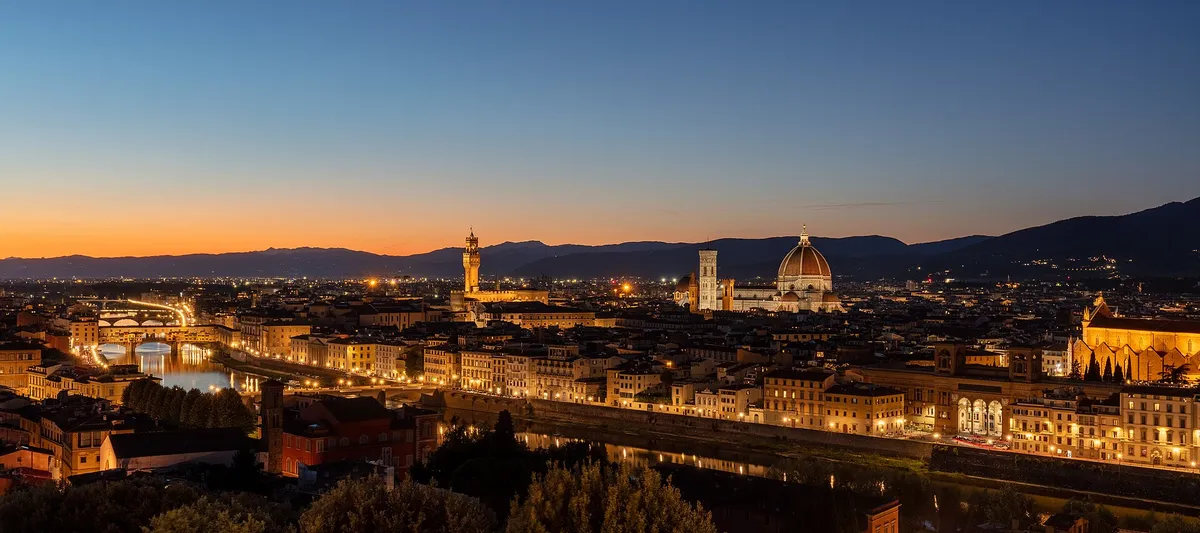
- Piazzale Michelangelo (the panoramic terrace above the Arno; the finest view of Florence; arrive at sunset): The bronze replica of David stands at the center; the panorama extends from the Duomo (center left) to Fiesole (northeast) to the Arno bend (west)
- Palazzo Pitti (the 15th-century Medici palace; the Palatine Gallery has the finest collection of Raphael paintings in the world — six works including the Madonna della Seggiola and the Velata)
Day 2: The Duomo, Baptistery, and Santa Croce
The Florence Cathedral (Cattedrale di Santa Maria del Fiore; the Duomo): The Brunelleschi dome (1420–1436; the largest masonry dome in the world, 42m diameter; the engineering innovation that launched the Renaissance — the double-shell construction without centering was unprecedented and unrepeated) is the defining element of Florence’s skyline.
The Climb: 463 steps to the lantern; the view from the drum level is the Florentine roofscape; the view from the lantern (91m) is the entire Arno valley.
The Baptistery (the octagonal San Giovanni, 11th–12th century): The Ghiberti Gates of Paradise (Porta del Paradiso; the east doors, 1425–1452; gold-leafed bronze): Michelangelo named them; 10 panels depicting Old Testament scenes in perspective — the first fully realized perspectival relief sculpture in history. (The original panels are in the Museo dell’Opera del Duomo; the doors on the Baptistery are high-quality replicas.)
Santa Croce (the Franciscan basilica; the largest in the world):
- Michelangelo’s tomb (the right aisle; monument by Vasari, 1570)
- Galileo’s tomb (the left aisle; transferred here in 1737)
- Machiavelli’s tomb (left aisle)
- The Bardi and Peruzzi Chapels (the earliest Giotto frescoes in Florence, 1310s — the ancestors of all subsequent naturalistic painting)
Day 3: Chianti Wine Road (Florence → Siena)
The Chianti Classico DOCG (the wine region between Florence and Siena; the Gallo Nero, the Black Rooster, is the trademark): The road from Florence to Siena via the Via Chiantigiana (the SS222 — the most scenic route rather than the direct superstrada) takes approximately 2 hours with stops, covering the core of the Chianti Classico zone.
Morning: Greve in Chianti (the main market town; 28km south of Florence):
- Piazza Matteotti: The triangular porticoed piazza with the wine shops, the weekly market, and the butcher Falorni (the finest finocchiona — the fennel-seed salami — in Chianti)
- Montefioralle (the medieval hamlet 2km uphill; the finest walled village in Chianti; the Romanesque church of Santi Stefano e Ciriaco; the view over the Greve valley)
Late Morning: Panzano in Chianti (14km south of Greve): Dario Cecchini (Via XX Luglio 11): The most famous butcher in Italy — the butcher who recites Dante’s Inferno over the cutting table; the Officina della Bistecca (dinner by reservation; €120; set menu built around the finest Chianina beef); the free salumi and red wine by the counter at lunch (no reservation required; one of the finest free eating experiences in Italy).
Afternoon: Castellina in Chianti and Radda in Chianti: The two finest hill towns in the Chianti Classico zone — medieval towers, wine cantinas (Rocca delle Macie, Brolio, Barone Ricasoli), and the Etruscan tombs (tumuli) scattered along the hillsides that predate the Romans by 500 years.
Evening: Siena (arrive for the passeggiata at sunset):
Day 4: Siena — The Medieval Rival
Siena (the medieval republic that was Florence’s equal until the Black Death of 1348 killed half the population; a city that has not grown significantly since the 14th century):
The Campo (Piazza del Campo; the shell-shaped central piazza, designed 1293): The finest public square in Italy — the scallop-shell shape slopes toward the Palazzo Pubblico at the base; the pavement is divided into nine sections by herringbone brickwork (representing the Council of Nine that governed the city’s golden age). The Fonte Gaia (the Jacopo della Quercia fountain, 1409–1419; the originals are in the Palazzo Pubblico; the replicas are in place) and the surrounding 14th-century palaces create the most unified medieval public space in Europe.
The Palio di Siena (the horse race; 2026 dates: July 2 and August 16): The most extraordinary annual event in Italy — 10 of the 17 contrade (city districts; each with its own church, museum, fountain, and animal symbol) compete in a 90-second bareback horse race around the Campo. The buildup to the race (the trial races on the preceding days; the banquets in the contrada territory the night before; the medieval pageant procession — corteo storico — immediately before the race) is as significant as the race itself.
The race has been run without interruption (except for two World War years) since 1644. The winning contrada celebrates in the streets until dawn; the losing jockey is sometimes beaten.
Siena Cathedral (Duomo di Siena; Piazza del Duomo): The finest Gothic cathedral in Italy — the black and white marble striping (the colors of the city’s balzana heraldic symbol), the unfinished expanded nave (the Facciatone — the facade of the nave that would have been the largest Gothic church in Italy, abandoned after the 1348 plague), and the extraordinary interior (the inlaid marble floor, the Nicola Pisano pulpit, the Piccolomini Library).
The Piccolomini Library (inside the Cathedral; €4 extra): The 15-fresco cycle by Pinturicchio (1502–1508) depicting the life of Cardinal Piccolomini (later Pope Pius II) — the finest narrative fresco cycle in Tuscany outside the Brancacci Chapel in Florence.
Day 5: San Gimignano and Val d’Orcia
Morning: San Gimignano — The Medieval Manhattan
San Gimignano (68km from Siena; the città delle belle torri, the city of beautiful towers): 14 medieval towers survive of the original 72 — the competing tower-building of the noble families of the 13th century produced the most vertical medieval townscape in Italy. The view from the Torre Grossa (the tallest surviving tower; 54m; the only one open to the public; the view is the most complete medieval hill town panorama in Tuscany) or from the approaching road from Poggibonsi (the towers on the skyline against the surrounding hills) is the defining San Gimignano image.
Vernaccia di San Gimignano (the white wine indigenous to San Gimignano; DOCG; the first wine to receive DOC status in Italy, 1966): The finest white wine in Tuscany — dry, minerally, with a slightly bitter almond finish; best drunk young (within 2 years). Cantina del Redi, Cusona, and Teruzzi are the finest producers.
The Collegiate (Collegiata di Santa Maria Assunta; Piazza del Duomo; €6): The finest fresco cycle in San Gimignano — the Old Testament scenes on the left wall by Bartolo di Fredi (1356); the New Testament scenes on the right wall by Lippo Memmi (1333); and the Last Judgment on the west wall by Taddeo di Bartolo (1393).
Afternoon: Val d’Orcia (UNESCO World Heritage Landscape)
The Val d’Orcia (the valley of the Orcia River, between Siena and Montalcino): The landscape painting of Ambrogio Lorenzetti’s Good Government Allegory (1338–40; in the Siena Palazzo Pubblico) is the first known landscape painting of the Val d’Orcia — the gentle hills, the isolated farmhouses (poderi), and the cypress trees on the ridges that he depicted are still largely unchanged.
Pienza (the “ideal Renaissance city” of Pope Pius II, 1459–1462; the town was entirely remodeled by the architect Bernardo Rossellino according to Pius II’s vision of the perfect humanist city):
- Piazza Pio II (the finest Renaissance piazza in Tuscany; the Cathedral, the Palazzo Piccolomini, and the Palazzo Pubblico aligned in perfect symmetry; the view from the Cathedral terrace over the Val d’Orcia to Monte Amiata)
- Pecorino di Pienza (the sheep’s milk cheese of the Val d’Orcia): The semi-aged pecorino stagionato (3–6 months; firm, nutty, with the sheep’s-milk tang) is the finest in Tuscany; the cheese shops on the Corso Rossellino are the primary producers.
Monticchiello (8km southeast of Pienza; the finest hamlet in Val d’Orcia): The cypress-lined road (viale dei cipressi) approaching the village — the most photographed road in Italy and the image most associated with Val d’Orcia.
Day 6: Montalcino and Montepulciano Wine Country
Montalcino and Brunello
Montalcino (the hilltop town, 35km south of Siena; the source of Brunello di Montalcino): Brunello di Montalcino (the Sangiovese Grosso grape; DOCG; the minimum aging is 5 years from harvest, including 2 years in oak and 4 months in bottle) is arguably the finest and most age-worthy Italian red wine — the best vintages (2001, 2004, 2006, 2010, 2012, 2015, 2016) can age 30–50 years.
Recommended producers with visitor programs:
- Biondi-Santi (the founding estate; the creator of Brunello, 1888; the most historically significant winery in Montalcino; visits by appointment)
- Il Poggione (the most consistent quality at mid-range prices; the visitor cellar is particularly well-organized)
- Poggio di Sotto (the cult Brunello; biodynamic; intense aromatics; visits by appointment)
Rosso di Montalcino (the 2-year-aged younger sibling of Brunello; DOCG; much cheaper but from the same vineyards): The finest everyday wine in the Val d’Orcia.
Montepulciano and Vino Nobile
Montepulciano (the hill town, 25km east of Pienza; the source of Vino Nobile di Montepulciano): The Vino Nobile (Prugnolo Gentile, a Sangiovese clone; DOCG; minimum 2 years aging including 1 year in oak) is the most underrated of the great Tuscan reds. The hill town (the Piazza Grande, the Palazzo Comunale, the Duomo) is the finest in the southern Senese hills.
The Cantineri (the wine cellars along the Corso, built into the medieval walls):
Day 7: Return to Florence via Arezzo
Arezzo (80km from Montepulciano; 1 hour; the most overlooked city in Tuscany):
The Basilica di San Francesco (Cappella Bacci; Piazza San Francesco; €12; reservation required): The Legend of the True Cross by Piero della Francesca (1452–1466) — the most significant fresco cycle in Italy after the Sistine Chapel. Piero’s spatial geometry (the lateral architectural sections at left and right; the figures in frontal and lateral view), his unprecedented handling of light (the nocturnal scenes of Constantine’s Dream and the Battle of Milvian Bridge are the first night scenes in Italian painting), and the integration of the landscape into the narrative make this cycle the foundation of Western spatial painting.
The Antiques Market (Fiera Antiquaria; first weekend of every month; Piazza Grande): The largest antiques market in Italy — 500 dealers in the Vasari arcade and the surrounding streets; furniture, ceramics, silver, prints, and paintings from the Medici era onward.
Piazza Grande (the sloping piazza designed by Vasari, 1573): The finest Renaissance piazza in eastern Tuscany — the loggia by Vasari (now housing the antique dealers), the apse of the Pieve di Santa Maria (the finest Romanesque church in Arezzo, 12th–14th century), and the Palazzo della Fraternità dei Laici (the Gothic-Renaissance hybrid facade, 1375–1460).
Practical Guide
Car rental: Reserve a compact manual-transmission car from Florence Airport or Hertz/Avis in the city center. The Chianti Classico roads are narrow (the Via Chiantigiana passes through the heart of the vine country on a road barely wide enough for two vehicles in some sections); a small car is an advantage.
The ZTL zones: All historic centers in Tuscany (Florence, Siena, Arezzo, San Gimignano, Pienza) are ZTL (Zona a Traffico Limitato) — private vehicles cannot enter without a permit. Park outside the historic center and walk in. In San Gimignano: Park at the Parcheggio Giubileo (the first large car park on the approach road); in Pienza: Park outside the city walls (free in the lower car parks).
Wine buying: Buy wine at the winery — prices at the cantina are typically 30–50% below what the same wine costs in a wine merchant. All Tuscan wineries accept credit cards; most will ship to EU countries.
Agriturismo: The Tuscan farmhouse accommodation (agriturismo) — the farm guesthouse with breakfast and often dinner included — is the finest way to stay in the Chianti and Val d’Orcia. Reserve at least 4–6 months ahead for summer.
FAQ
When is the best time to drive through Tuscany? May (post-wildflower bloom; the vines in leaf; the poppy fields in the Val d’Orcia; relatively uncrowded) and September–October (the harvest season; the vendemmia is underway; the light is golden; the heat is manageable). July–August is extremely hot (35–40°C), extremely crowded (the beach-going Italians from Rome and Milan drive through Tuscany every August), and expensive.
How many days do you need for Tuscany? 5 days minimum (Florence 2; Chianti 1; Siena 1; Val d’Orcia 1). 7–10 days to include Montalcino, Montepulciano, Arezzo, and the Maremma coast.
What is the best Chianti wine to buy? Pèppoli (Antinori; mid-range; the entry point to Antinori Chianti Classico), Il Grigio (San Felice; the most age-worthy at its price), and Ser Lapo (Mazzei, Fonterutoli; the most mineral and structured of the modern style).