
Photo: A.Savin / Wikimedia Commons
Best Hotels in Warsaw: Old Town, Śródmieście & the Rebuilt Capital (2026)
Raffles Europejski's Lourse patisserie and Ptasie Mleczko tradition, the Bristol Hotel's century-old Chopin Suite, and Hotel de Silva's modern Śródmieście design — the best hotels in Warsaw, Poland's rebuilt capital, for 2026.
Warsaw: The Most Surprising Capital in Europe
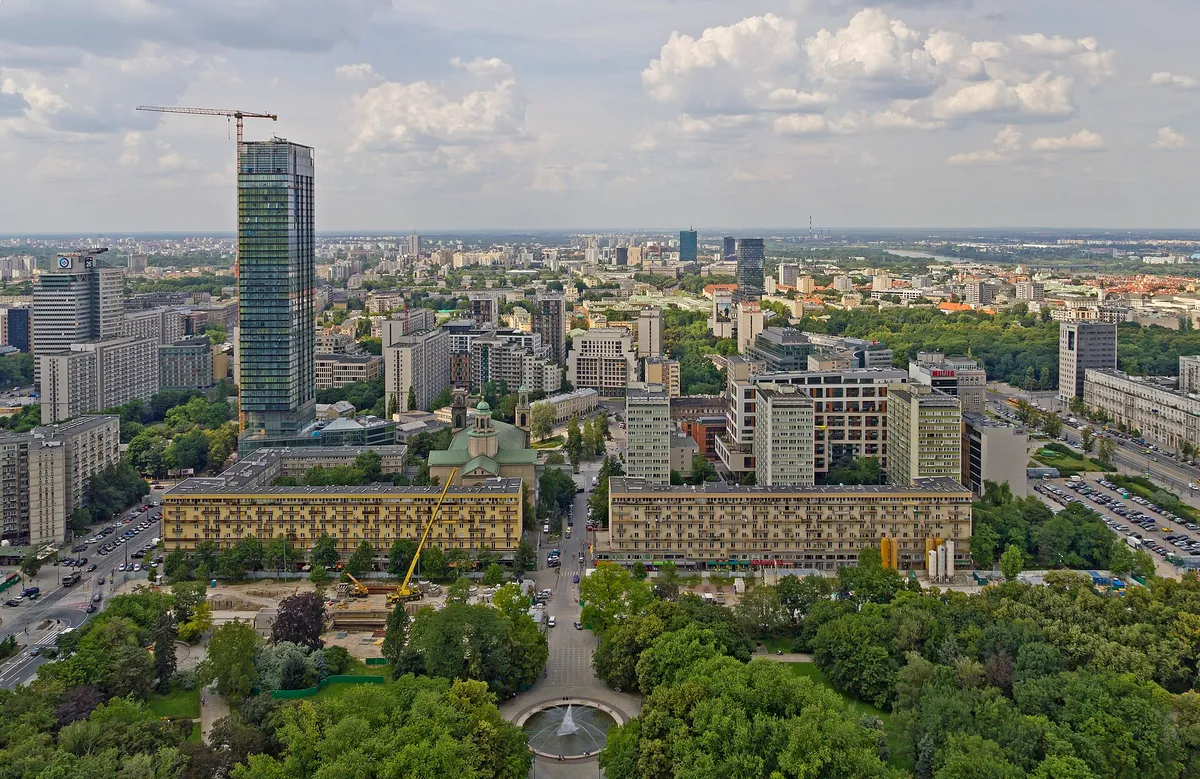
Warsaw is one of Europe’s most surprising capitals. The city was 85% destroyed during WWII — the Warsaw Uprising (August–October 1944) saw the Home Army resist Nazi German forces for 63 days, at a cost of roughly 200,000 Polish civilian lives, before Heinrich Himmler ordered the systematic, building-by-building destruction of Warsaw in reprisal, one of the most deliberate acts of urban destruction in history. The city was then rebuilt almost entirely from historical documentation: paintings by Bernardo Bellotto (Canaletto’s nephew) of 18th-century Warsaw served as the primary architectural reference for the postwar reconstruction of the Old Town, which UNESCO designated a World Heritage Site in 1980 as an unusual example of “near-total reconstruction.”
The result is a genuinely unusual historical experience — an Old Town where every building postdates 1945 but every stone was placed to recreate the pre-war city, paired with one of Central Europe’s most economically dynamic capitals: a thriving startup scene, a creative culture, and a restaurant scene that has arguably overtaken Prague’s and Kraków’s as the most exciting in Poland.
Krakowskie Przedmieście — The Royal Route
Hotel Bristol Warsaw — The Chopin Legacy
Price: €150–800/night | Location: Krakowskie Przedmieście 42/44, Warsaw
Hotel Bristol Warsaw (1901) is Poland’s most historically significant hotel, a Secessionist building on Krakowskie Przedmieście — the “Royal Route,” Warsaw’s most important boulevard, running 1.5km from the Royal Castle to Łazienki Park past baroque palaces, St. Anne’s Church, and the Presidential Palace.
Its Chopin Suite is where Ignacy Jan Paderewski — celebrated concert pianist, the first Prime Minister of independent Poland after WWI, and a longtime Bristol resident — practiced and performed, making it one of the most historically significant hotel rooms in Poland. The Bristol Bar, a reconstruction of the 1901 interior, was once a gathering point for the pre-war intelligentsia. And the Marconi Restaurant serves some of the best traditional Polish cooking in Warsaw’s luxury hotels: bigos (the hunter’s stew of sauerkraut, fresh cabbage, pork, wild mushrooms, and kiełbasa, cooked for three days), żurek (sour rye flour soup), and pierogi ruskie (dumplings stuffed with potato and cottage cheese).
Raffles Europejski Warsaw — The Legendary Patisserie
Price: €200–1,500/night | Location: Krakowskie Przedmieście 13, Warsaw
Raffles Europejski Warsaw reopened in 2018 after restoring the original 1857 Europejski Hotel — Raffles’ first entry into Eastern Europe and one of the most anticipated hotel openings in Poland that decade. Its Lourse Patisserie carries on a well-loved Polish confectionery tradition: Ptasie Mleczko (soft nougat covered in dark chocolate, one of Poland’s most beloved sweets) and kremówka (the “papal cream cake” associated with Pope John Paul II, who grew up in Wadowice). The Europejski Grill rounds things out with a strong Polish wine and spirits list and contemporary Polish cuisine.
Śródmieście — The City Center
Autograph Collection Hotel de Silva — Modern Center
Price: €120–500/night | Location: ul. Świętokrzyska 36, Warsaw
Hotel de Silva Warsaw, in Śródmieście, is a strong contemporary design choice for business travelers and cultural visitors, with a notable Polish art collection, the Kulturalna restaurant, and easy access to the National Museum of Warsaw. The museum’s collection includes Jan Matejko’s Battle of Grunwald (depicting the 1410 battle that broke the power of the Teutonic Knights) and his Sobieski at Vienna (commemorating Jan III Sobieski’s 1683 defeat of the Ottoman Turks at the Battle of Vienna) — two of the most important paintings in Polish history.
Jewish Warsaw — The Most Important Memorial in Europe
The POLIN Museum District
The POLIN Museum of the History of Polish Jews, which opened in 2014, is one of the most significant Jewish history museums in the world. Its exhibits trace 1,000 years of Jewish life in Poland — the medieval Jewish community, shtetl culture (Poland was home to 3 million Jews before WWII, the largest Jewish population anywhere), and the Holocaust, in which 90% of Polish Jews were murdered. The building, designed by Rainer Mahlamäki, has an undulating form meant to evoke the parting of the Red Sea, and it stands on the site of the former Warsaw Ghetto, near the Ghetto Uprising memorial, the Umschlagplatz, and Pawiak prison.
Warsaw Food Culture
The New Polish Cuisine
Warsaw has one of the most exciting restaurant scenes in Central Europe, driven by the “New Polish Cuisine” movement — a revival of Polish culinary heritage using contemporary technique, the Chef’s Table Warsaw format, ingredients foraged from Polish forests and mountains, and a resurgent Polish wine industry (more than 300 wineries now producing dry whites in the Małopolska Upland, among other surprises):
- Ale Gloria reimagines the traditional milk bar (Bar mleczny) as fine dining, elevating Polish comfort food
- Senses is Warsaw’s most internationally recognized restaurant, with a Michelin-starred contemporary Polish tasting menu
- Charlotte Menora serves Jewish-Polish fusion on Próżna Street, home to the only pre-war building still standing in the former Warsaw Ghetto
FAQ
Is the Warsaw Old Town really rebuilt? Yes — UNESCO’s World Heritage designation explicitly describes the Warsaw Old Town as an “almost entirely reconstructed” historic center, an unusual designation granted in 1980 for the significance of the postwar reconstruction as a cultural act rather than for original authenticity. Every building in the Old Town dates from 1945–1980, rebuilt using Bernardo Bellotto’s paintings alongside historical photographs and documentation. The Market Square (Rynek Starego Miasta) and its surrounding streets remain one of the finest examples of historical reconstruction anywhere — genuinely beautiful despite their artificial origin.
When is the best time to visit Warsaw? May–September for the best weather: mild temperatures of 20–24°C in May–June, long evenings, and the free Sunday Chopin Concerts at the composer’s monument in Łazienki Park, one of Europe’s most beloved outdoor classical music series. December is worth considering for the Christmas markets, especially the Old Town market, among the most atmospheric in Central Europe outside Prague and Vienna.
How does Warsaw compare to Kraków? Warsaw is the more contemporary, fastest-developing, and cosmopolitan of the two, with the stronger food and contemporary art scene. Kraków is more traditionally beautiful, more historically intact, and has the better medieval architecture (Wawel Castle, and the Main Market Square, the largest medieval market square in Europe), along with a more romantic atmosphere. The PKP InterCity express covers the route in 2h15min, making the two cities an easy combined itinerary.