
Photo: Matheenfaiz / Wikimedia Commons
Winter Sun Destinations from Europe: Where to Go December–March (2026)
The Canary Islands' year-round sunshine, the Maldives' peak season, and 10 more destinations within 6 hours that offer warmth when northern Europe is at its darkest — the 2026 guide.
Why Winter Sun Matters
Northern and Central Europe in December–February: average high of 3–8°C (London, Berlin, Amsterdam, Warsaw), 3–5 hours of daylight, grey skies, and the psychological weight of the darkest months. The combination of affordable winter flight prices (peak summer routes running at winter low-demand pricing) and the proximity of warm destinations makes winter sun travel one of the most rational and popular European travel patterns.
This guide covers the best winter sun options at different flight-time and budget levels.
Under 4 Hours from Most of Europe
Canary Islands (Spain) — The Winter Sun Standard
Distance from London: 4 hours | Distance from Berlin: 5 hours | Distance from Rome: 3.5 hours
The Canary Islands (Tenerife, Gran Canaria, Lanzarote, Fuerteventura, La Palma, La Gomera) are Europe’s winter sun standard — year-round warmth (20–24°C in December–February), volcanic landscapes shaped by centuries of eruptions, the most reliable sunshine of any European territory, and direct flights from virtually every European airport.
Tenerife: The largest and most varied island — Teide National Park (the third largest volcanic structure on earth, snow-capped summit visible from the coast in winter), the Anaga Rural Park (ancient laurisilva forest, the most primeval landscape in the Canaries), and the resort areas of the south (Playa de las Américas, Costa Adeje) and north (Puerto de la Cruz, the most characterful town).
Lanzarote: The most dramatic landscape — the volcanic lava fields of the Timanfaya National Park, the white architecture influenced by César Manrique (the island’s famous artist-architect who defined Lanzarote’s visual identity), and the Jameos del Agua (volcanic cave with a subterranean lake containing endemic blind albino crabs — one of Manrique’s most striking architectural interventions anywhere in the world).
Best for: Families, beach holidays, reliable warmth at affordable prices
Madeira (Portugal)
Distance from London: 3.5 hours
Madeira in December–March has a lot going for it — the island’s subtropical climate makes it warmer than the Canaries (22–24°C), the dramatic mountain landscapes (the central peaks over 1,800m), the levada walking trails (the ancient irrigation channels carved into the mountain sides, now some of Europe’s finest coastal and mountain walking routes), and the spectacular New Year’s Eve fireworks (officially the world’s largest, visible from the hillsides above Funchal) make Madeira the most underrated winter destination from Europe.
Morocco (Marrakech, Essaouira)
Distance from London: 3.5 hours
Morocco in winter is pleasant but not warm — Marrakech in December–January: 15–20°C, occasionally cold at night. Essaouira (the coastal city, 2 hours from Marrakech) is windswept but beautiful. Neither is a “sun beach” destination in winter; both are excellent cultural destinations with comfortable temperatures for city exploring (unlike July–August, when Marrakech at 40°C makes daytime outdoor exploration very difficult).
4–6 Hours from Europe
Dubai and Abu Dhabi (UAE)
Distance from London: 7 hours | Distance from Frankfurt: 6 hours | Distance from Warsaw: 5.5 hours
Dubai and Abu Dhabi in December–February: 22–28°C, almost no rain, and the region’s entire infrastructure (the beaches, the pools, the outdoor activities) is designed for winter use — locals and tourists alike use the beaches in winter (the sea temperature is 24°C, warmer than most European summers). The artificial islands, the vast air-conditioned shopping malls, the desert safari industry, and the architectural exhibition of the two cities are all best experienced in winter.
Practical: Dubai is expensive for accommodation (Dh600–1,200/night for mid-range = €150–300); Abu Dhabi is slightly more affordable. The Louvre Abu Dhabi (Jean Nouvel’s museum building, set under a perforated aluminum dome that creates a “rain of light” effect) and the Sheikh Zayed Grand Mosque (the most beautiful mosque in the Arab world, white marble, capacity 40,000) justify spending time in Abu Dhabi alongside Dubai’s entertainment offerings.
Egypt — Hurghada and Sharm el-Sheikh (Red Sea)
Distance from London: 5 hours | Distance from Warsaw: 4 hours
The Red Sea resorts in winter (December–March): 22–26°C, exceptional diving visibility (30+ meters), and reef biodiversity that includes 1,200 fish species (10% endemic). Hurghada is more developed and has more direct European flights; Sharm el-Sheikh has better reef access.
For those interested in ancient Egypt: Cairo in December–February is the ideal visiting condition (20–25°C, compared to 36–42°C in summer) — the Pyramids, the Egyptian Museum (moving to the new Grand Egyptian Museum adjacent to Giza), and Luxor’s Valley of the Kings are all best visited in winter.
Maldives
Distance from London: 10.5 hours | Distance from Frankfurt: 9 hours
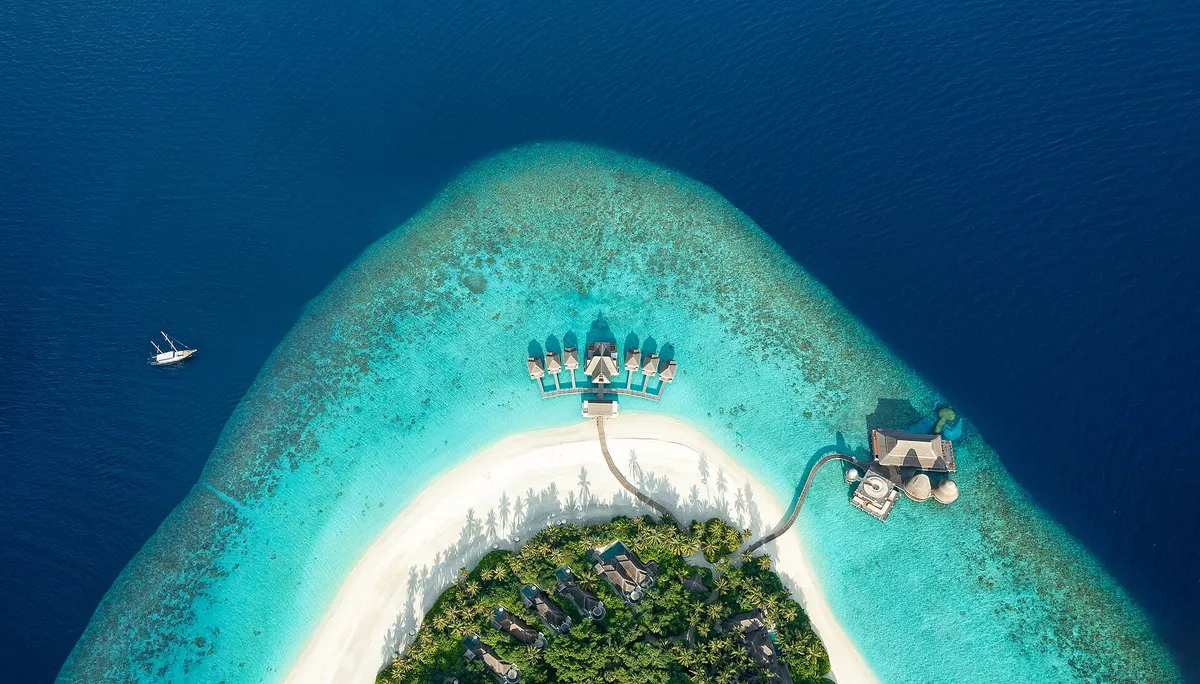
The Maldives in December–April is at its absolute peak — the northeast monsoon’s dry season, the clearest seas, the calmest conditions. The distance (10+ hours) makes it a long-haul trip rather than a short break; for the right occasion (honeymoon, anniversary, the once-in-a-decade trip) it is the world’s finest winter sun destination.
Sri Lanka
Distance from London: 10 hours
Sri Lanka in December–February: the southwest monsoon has ended and the south and west coasts (Mirissa, Galle, Colombo) are at their best — warm (27–30°C), calm seas, perfect for the southern beach circuit. The cultural triangle (Kandy’s Temple of the Tooth, the cave paintings of Sigiriya, the ancient cities of Anuradhapura and Polonnaruwa) is best visited in the same period.
Whale watching: Mirissa (the southern tip of Sri Lanka) hosts the largest blue whale aggregation accessible to tourists in the world in January–April — the world’s largest animal, in numbers, within 1–2 hours of a coastal hotel.
The Europe’s Southern Edge Option
Sicily (Italy)
Temperature December: 14–17°C | Sunshine: 5 hours/day
Sicily is not “sun beach” territory in December–March (the water is 15–16°C, not swimmable for most Europeans), but Palermo in February (18°C, mostly dry) rewards a visit — the Arab-Norman architectural heritage (the Palatine Chapel, the Cathedral of Monreale, whose medieval mosaic interior is surpassed in scale only by the Hagia Sophia), the street food (the Ballarò and Vucciria markets, the arancini, the sfincione pizza, the granita with brioche), and the complete absence of the summer crowd make it an excellent late winter escape.
Andalusia (Spain)
Temperature December: Seville 15°C, Malaga 18°C
Andalusia in winter is genuinely good — Seville and Granada have 5–6 hours of sunshine in December, temperatures of 15–19°C (perfect for walking the Alhambra without the summer heat), with flamenco, tapas, and the architectural legacy of the Moorish period all still going strong in the off-season. The Costa del Sol (Malaga, Nerja, Marbella) is warmer than inland Andalusia (18–22°C in December–January) with beach walks possible if not swimming.
Quick Reference by Priority
| Priority | Destination | Flight from London | Winter Temp |
|---|---|---|---|
| Guaranteed warmth | Canary Islands | 4 hrs | 20–24°C |
| Warmth + culture | Dubai | 7 hrs | 24–28°C |
| Warmth + scenery | Madeira | 3.5 hrs | 22–24°C |
| Culture + mild | Morocco | 3.5 hrs | 15–20°C |
| Luxury beach | Maldives | 10.5 hrs | 28–31°C |
| Adventure + reef | Red Sea (Egypt) | 5 hrs | 22–26°C |
| Culture + mild | Andalusia | 2.5 hrs | 15–22°C |
FAQ
Is the Canary Islands experience worth the flight when you can go to Southeast Asia for similar warmth at longer distance? Yes for short breaks (4–7 days) — the Canary Islands justify the trip for a week’s beach holiday in a way that Southeast Asia (10+ hours, significant jet lag, visa requirements) doesn’t. For 2+ weeks, Southeast Asia or the Maldives offer more exotic experiences; for 1 week of reliable warmth without complexity, the Canaries win.
Is Morocco warm in December? Warm by northern European standards (15–20°C Marrakech) but not beach weather. The appeal of Morocco in winter is cultural (the medinas are most comfortable when it’s not 40°C), not beach-based.
What are the best airlines for Canary Islands from Central/Eastern Europe? Ryanair and easyJet have the best coverage from most European cities; Jet2 and TUI (from UK) are the traditional package holiday operators with sometimes better resort-hotel packages. Norwegian offers competitive prices from Scandinavian cities.