
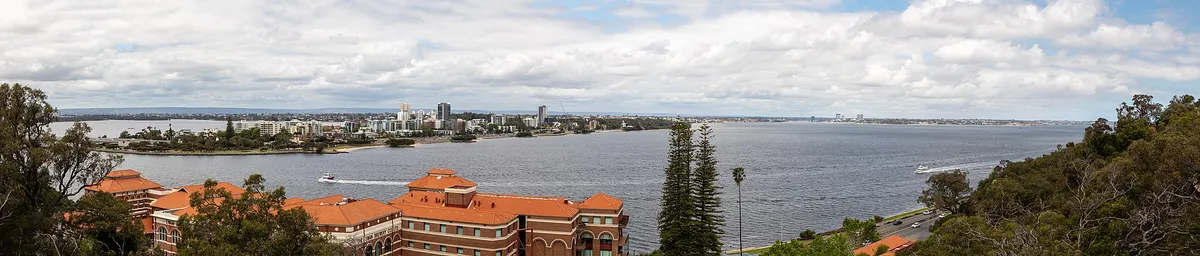
Photo: Dietmar Rabich / Wikimedia Commons
Where to Stay in Perth: Best Neighborhoods & Hotels (2026)
Perth CBD for urban access, Cottesloe for Indian Ocean beaches, Fremantle for colonial charm — this guide covers the best Perth bases for travelers in 2026.
TL;DR
- Best for most travelers: Perth CBD — walkable, easy transport to beaches and airport
- Best for beach life: Cottesloe or Scarborough — Indian Ocean beach access
- Best for character: Fremantle (20 km south) — historic port city, laneways, coffee culture
- Best budget: Northbridge (adjacent to CBD) — restaurants, hostels, cultural precinct
- When to book: Perth is manageable; 3–4 weeks ahead is usually sufficient, more for major events
Best Neighborhoods in Perth
Perth is Australia’s most isolated major city — 2,700 km from the nearest comparable city (Adelaide) and facing the Indian Ocean. This isolation has created a distinct, confident culture and a surprisingly excellent food, wine, and outdoor scene. The city sprawls along the Swan River with beaches to the west. Most visitors base themselves in the CBD or nearby neighborhoods, with Fremantle as a popular alternative base.
| Neighborhood | Vibe | Price Range | Best For |
|---|---|---|---|
| Perth CBD | Central, walkable | €60–350/night | Most travelers, business |
| Northbridge | Entertainment, budget | €30–180/night | Nightlife, arts, budget |
| Fremantle | Historic, character | €55–250/night | Colonial history, coffee |
| Cottesloe Beach | Beach, relaxed | €80–300/night | Indian Ocean swimming |
| South Perth | Riverside, quiet | €60–200/night | Families, zoo access |
Perth CBD — The City Center
Perth’s CBD is more livable and walkable than most Australian city centers — the Swan River defines the southern edge, Kings Park (one of the world’s largest inner-city parks, larger than Central Park) anchors the western side, and the pedestrianized Hay Street and Murray Street malls run through the shopping core. The city’s best restaurants have concentrated in the CBD and its inner-ring neighborhoods over the past decade.
Who it’s for: First-time visitors, business travelers, those wanting easy transport to the airport (30 minutes by train) and beaches (30–45 minutes by bus or train).
Price range: Budget from €55/night; mid-range hotels €90–180/night; luxury options €160–350/night.
The COMO The Treasury Perth in the restored 1874 State Buildings is Perth’s most acclaimed luxury hotel — a converted historic precinct with some of Australia’s finest hotel design at €280–500/night. The Pan Pacific Perth is a reliable international business hotel at €130–220/night. Budget options in the CBD are limited; Northbridge (adjacent) is the better budget zone.
Northbridge — Perth’s Cultural Quarter
Northbridge is immediately north of the CBD, separated by the train line — Perth’s most culturally active neighborhood, with the Art Gallery of Western Australia, the Western Australian Museum, the Perth Institute of Contemporary Arts, and the highest concentration of restaurants, bars, and nightclubs. It’s also the most diverse neighborhood in the city.
Who it’s for: Budget travelers, nightlife enthusiasts, food-focused travelers, and those interested in arts and culture.
Price range: Hostels from €25/night; guesthouses €45–90/night; mid-range hotels €70–150/night.
Several well-run hostels and budget hotels in Northbridge offer good value from €30–60/night for private rooms. The Alex Hotel is an excellent boutique option on the Northbridge-CBD border at €100–180/night.
Fremantle — Perth’s Port City
Fremantle is 20 km south of Perth, connected by a 30-minute train — a Victorian-era port city with extraordinary heritage architecture (the Fremantle Prison, the Round House jail, the market buildings), an acclaimed coffee culture (Fremantle has some of Australia’s best cafes), craft breweries (Little Creatures is based here), and a character quite distinct from the CBD. Many travelers prefer Fremantle as a base and day-trip to Perth CBD.
Who it’s for: Those interested in history and architecture, coffee enthusiasts, those who value a more intimate town feel over big-city access, and travelers who’ve been to Perth before.
Price range: €55–250/night; boutique hotels and guesthouses throughout.
The Esplanade Hotel Fremantle - by Rydges is Fremantle’s landmark accommodation — a large heritage hotel on the main esplanade at €100–200/night. Several boutique guesthouses on High Street and the surrounding laneways offer atmospheric options at €65–110/night.
Cottesloe Beach — The Indian Ocean
Cottesloe is Perth’s most famous beach suburb — a stretch of white sand and the clearest blue ocean water imaginable, lined with the Indiana Teahouse (famous colonial-era restaurant), Norfolk Island pine trees, and a surf club. It’s 30 minutes by train from Perth CBD and represents one of Australia’s great urban beach experiences.
Who it’s for: Beach-focused travelers, families, and anyone for whom Indian Ocean swimming is a primary reason for visiting Perth.
Price range: €80–300/night; mostly mid-range and upscale options in the surrounding suburb.
The Cottesloe Beach Hotel (a classic Australian pub hotel) offers good value at €100–180/night with direct beach proximity. Several boutique guesthouses and serviced apartments in the Cottesloe area run €80–140/night.
How to Book
Perth’s hotel market is relatively accessible. Demand spikes during: Australia Day (January 26 — fireworks on the Swan River), Perth Festival (February–March), major concerts at Optus Stadium, and the Margaret River Premium wine & food festival (May — many visitors base in Perth). Book 4–6 weeks ahead for these events.
Best season: September to November (spring — wildflowers, whale watching at Ningaloo, excellent temperatures 22–28°C) and March to May (autumn, still warm, no crowds). June to August are the mildest winter days in Australia (15–18°C) but rainy and cooler for the beach.
FAQ
Is Perth worth visiting? Yes — Perth’s isolation is actually an asset: it’s forced the city to develop excellent food, wine, and outdoor culture rather than relying on tourism from other Australian capitals. The Indian Ocean beaches, Margaret River wine region (3 hours south), the Pinnacles Desert, Rottnest Island (quokkas, car-free island, 30-minute ferry), and the recent urban transformation of the CBD all make Perth a compelling destination.
How do I get to Rottnest Island? Ferries run from Perth (Barrack Street Jetty, 90 minutes) or Fremantle (30 minutes). Day-trip and overnight accommodation options exist on the island. No cars are permitted on Rottnest — bicycles are the primary transport. The quokka (a small marsupial that photographs with visitors) has become one of Australia’s most famous wildlife experiences and is found only on Rottnest and a few other small islands.
What is Margaret River and is it worth a day trip? Margaret River (270 km south, 3 hours by car) is one of Australia’s premier wine regions — particularly strong for Cabernet Sauvignon and Chardonnay, with some exceptional boutique producers. It’s also a major surf destination and has beautiful caves (Mammoth Cave, Lake Cave). It’s too far for a comfortable day trip; 2–3 nights is better to do it justice.
What is the time zone difference from eastern Australia? Perth (AWST) is UTC+8, which is 2 hours behind Sydney (AEST, UTC+10) in summer, or 3 hours behind during eastern states’ Daylight Saving Time. This is frequently relevant when booking connecting flights or calling eastern-Australian contacts from Perth.