
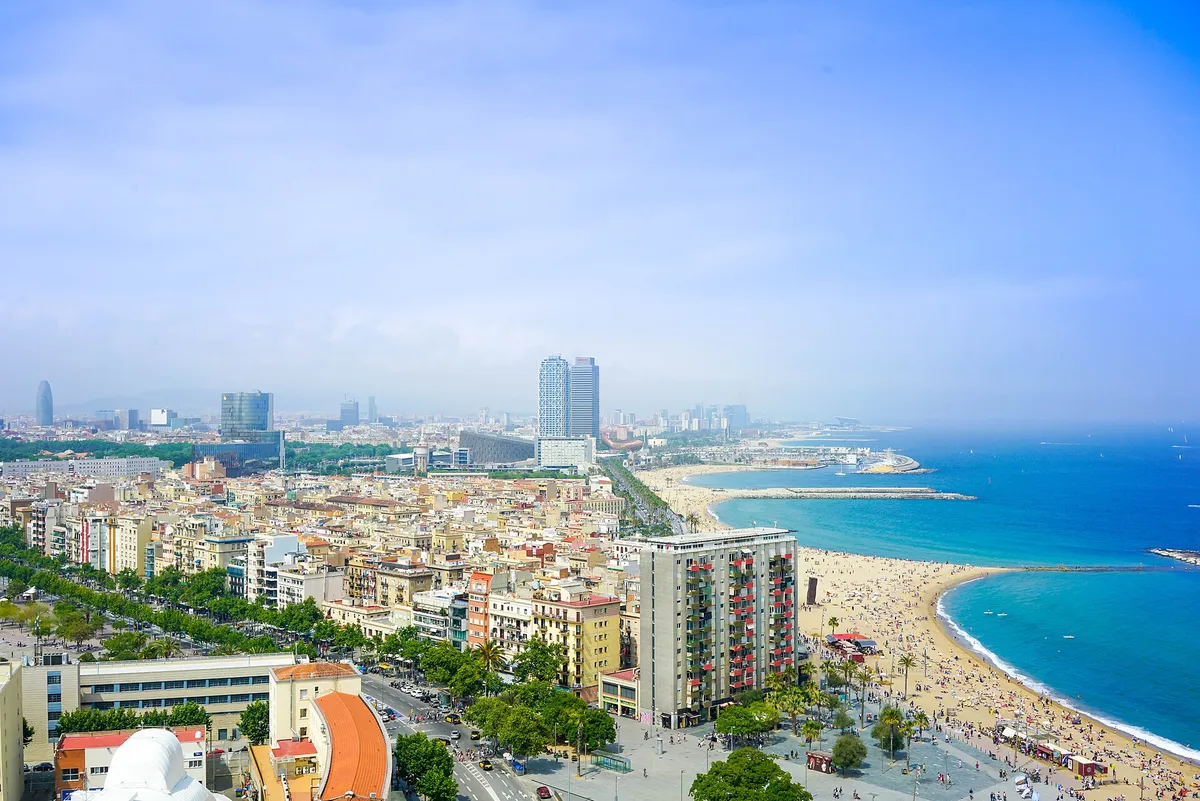
Photo: Enes royalfound / Wikimedia Commons
Where to Stay in Barcelona: Gothic Quarter, Eixample & Barceloneta (2026)
The Gothic Quarter's medieval alleys vs. the Eixample's Modernista boulevards vs. Barceloneta's beach access — the definitive guide to choosing your Barcelona neighborhood in 2026.
Barcelona’s Neighborhood Personality
Barcelona is a city of distinctly different neighborhoods — the Gothic Quarter’s medieval street plan (the 2,000-year-old Roman grid, the narrow alley network, the cathedral at its heart), the Eixample’s Modernista architecture (the Gaudí buildings — the Sagrada Família, the Casa Batlló, the Casa Milà — but also the Domènech i Montaner masterworks: the Palau de la Música Catalana, the Hospital de la Santa Creu i Sant Pau), the Barceloneta’s beach culture (the most accessible city beach in Europe after Nice), and Gràcia’s village-in-the-city atmosphere.
The neighborhood choice matters more in Barcelona than in almost any other European city. Staying in the Gothic Quarter (dense atmosphere, medieval streets, but significant tourist density) versus staying in the Eixample (the 19th-century grid, the city’s best restaurants and shopping, quieter but less atmospheric) is a fundamentally different Barcelona experience.
Gothic Quarter (Barri Gòtic) — Medieval Maximum
Character: The Gothic Quarter is the oldest continuously inhabited part of Barcelona, with 2,000 years of Roman settlement history — the Temple of Augustus, the 4th-century Roman walls incorporated into the current buildings, and the Cathedral of Barcelona (La Catedral, to distinguish it from the Sagrada Família). Its medieval architecture is unmatched in the city, but so is its tourist density. The neighborhood highlights: the Carrer del Bisbe (the most photographed street in the quarter, with its neo-Gothic bridge overhead), the Plaça Reial (the 19th-century square with Gaudí lampposts and outdoor restaurants), and the adjacent Barri de Sant Pere i Santa Caterina — slightly less touristed, home to the colorful Santa Caterina Market.
Best for: Maximum proximity to the Gothic Quarter’s own attractions; the closest hotel access to Las Ramblas (the famous and deeply touristy 1.2km boulevard — visit, but steer clear of the obvious tourist traps, the overpriced restaurants, and the pickpockets); atmospheric hotel interiors — the Gothic Quarter has the highest concentration of historically interesting buildings converted to hotels in Barcelona.
Best Gothic Quarter hotels:
- Hotel Neri Relais & Chateaux (the standout of the Gothic Quarter — a 12th-century building beside the Roman walls, with a wonderfully atmospheric courtyard, €250–800/night)
- El Palace Barcelona (the grand luxury hotel at the top of Las Ramblas — Barcelona’s traditional grand hotel par excellence, €350–2,000/night)
- Ohla Barcelona (design boutique on the Via Laietana, known for its ceramic-button façade by Frederic Amat and the excellent Saüc restaurant, €200–600/night)
Eixample — Modernista Elegance
Character: The Eixample (pronounced “Ay-SHAM-pleh” — Catalan for “expansion”) is Barcelona’s 19th-century planned extension beyond the old walls: an octagonal grid designed by Ildefons Cerdà in 1859, whose chamfered corners create distinctive small squares at every intersection — the most influential urban planning concept in 19th-century Europe. The Eixample contains Gaudí’s two most important buildings (the Sagrada Família and the Casa Milà/La Pedrera), the Passeig de Gràcia — Barcelona’s most elegant boulevard, including the Mansana de la Discòrdia (the “Block of Discord”) where Casa Batlló, Casa Amatller, and Casa Lleó Morera stand within a single block — and the city’s leading restaurant and boutique retail scene.
The Esquerra de l’Eixample (Left Eixample, the LGBTQ+ neighborhood — the “Gayxample”) has the most concentrated bar and nightlife scene in Barcelona.
Best for: Maximum proximity to the major Gaudí buildings (the Casa Batlló and La Pedrera are in the upper Eixample; the Sagrada Família is in the Sant Martí neighborhood but effectively an Eixample walking destination); Barcelona’s top restaurants (Disfrutar — 3 Michelin stars and the hardest table in the city, with reservations opening 6 months ahead; Tickets by Albert Adrià; Bodega Sepúlveda for natural wine); the best shopping (Passeig de Gràcia luxury retail, Carrer de Provença independent boutiques).
Best Eixample hotels:
- Mandarin Oriental Barcelona (a converted mansion on Passeig de Gràcia, with the Bistreau restaurant and a serious spa, €400–3,000/night)
- Monument Hotel (a Monumental Classicism building on Passeig de Gràcia, home to the excellent Lasarte restaurant (3 Michelin stars), €300–1,500/night)
- Hotel Casa Fuster (a 1908 Modernista building by Lluís Domènech i Montaner, with the storied Café Vienès, €200–800/night)
- Almanac Barcelona (polished contemporary design and a rooftop pool, €200–700/night)
Barceloneta — Beach Access
Character: Barceloneta is Barcelona’s beach neighborhood — an 18th-century fishing village grid that remains the densest urban fabric in the city, with narrow streets, a deep seafood culture, and direct beach access (Barceloneta Beach, the most visited urban beach in Europe, is 1.1km long). Its chiringuito (beach bar) culture is a way of life. The neighborhood runs from the Barceloneta beach park to the Port Olímpic, the marina built for the 1992 Barcelona Olympics, now a nightclub and restaurant complex.
Best for: Travelers whose primary Barcelona interest is the beach; seafood — Barceloneta has the city’s greatest concentration of seafood restaurants, serving paella, fideuà (the Catalan pasta paella), and fresh fish grills; the most convenient access to the Port Vell and the Barcelona Aquarium.
Best Barceloneta hotels:
- Hotel Arts Barcelona (a 44-story tower on the beach — no pool in Barcelona is better positioned, with the Frank Gehry fish sculpture in view and the beach and Mediterranean below; the excellent Enoteca restaurant holds 2 Michelin stars, €350–2,500/night)
- W Barcelona (the “Sail” building on the Barceloneta pier, with a superb pool and the BRAVO24 restaurant by Carlos Abellán, €250–1,500/night)
Gràcia — Village Authenticity
Character: Gràcia — an independent municipality incorporated into Barcelona in 1897 and still considered a village by its residents, with a fiercely independent character and a rich festival culture — is the most authentic neighborhood for extended Barcelona stays. The Plaça del Sol, the Plaça de la Vila de Gràcia, and the Carrer de Verdi (with its independent cinema culture) sustain a community life that is entirely separate from the tourist Barcelona experience.
Best for: Extended stays (5+ nights), return visitors, and travelers who want the authentic working-class neighborhood experience alongside the tourist highlights; it is also the closest neighborhood to Park Güell — Gaudí’s park of mosaic terraces, gingerbread gatehouses, and the colonnaded hall, perhaps the most magical 30 minutes in Barcelona, best seen at the 07:30 general access time before the timed-entry queues begin.
Best Gràcia hotels:
- Generator Barcelona (a hostel-and-hotel hybrid — the best value for younger travelers in the creative Barcelona spirit, from €30/dorm bed, €80–200/private room)
- Casa Gracia (a likeable boutique in a modernista building on the Passeig de Gràcia fringe, good value for the location, €100–300/night)
Comparison Summary
| Neighborhood | Best For | Price Level | Tourist Density |
|---|---|---|---|
| Gothic Quarter | Medieval atmosphere, first-time visitors | High | Very high |
| Eixample | Gaudí buildings, fine dining, shopping | High | Moderate-high |
| Barceloneta | Beach, seafood, water sports | High | High (summer) |
| Gràcia | Authenticity, extended stays, Park Güell | Moderate | Low-moderate |
FAQ
Which Barcelona neighborhood is best for a first visit? The Eixample or the Gothic Quarter — the Eixample for maximum Gaudí building access and the city’s best dining; the Gothic Quarter for atmospheric hotels and medieval character. The practical argument for the Eixample: the Sagrada Família (15 minutes walk or 2 metro stops), the Casa Batlló and La Pedrera (walking distance on Passeig de Gràcia), and the top restaurants are all easily accessible.
Is Barcelona safe? Barcelona is one of the highest pickpocket-risk cities in Europe — Las Ramblas and the Gothic Quarter are particularly active. The precautions: money belt for passports and cards; phone in an inner pocket; awareness in crowded areas. The tourist neighborhoods are entirely safe for walking at night; late-night caution applies to isolated streets in the Barri Gòtic and the area around the Estació de França.
When does Barcelona become too crowded? June–September (the peak season, especially July–August) brings extreme crowds to the Sagrada Família (2-hour queue without advance booking), the Gothic Quarter, and Las Ramblas. Spring (April–May) and autumn (October) provide significantly better conditions. Book Sagrada Família tickets (€26–50/person depending on the tour) at least 2–4 weeks ahead year-round; book 2–3 months ahead for July–August.