
Photo: Unknown (prototype asset) / project prototype
Singapore First-Timer Guide: 3 Days in the Lion City (2026)
Complete 3-day Singapore itinerary for first-time visitors. Marina Bay, Sentosa, hawker centres, MRT tips and the best hotels — updated for 2026.
Singapore is one of the world’s most visitor-friendly cities — immaculately clean, logistically seamless, and packed with more cultural, culinary, and architectural interest than most cities three times its size. For a first-time visitor, three days is exactly the right amount of time: enough to cover the essential sights without the itinerary becoming a forced march, and enough downtime to do what Singapore really rewards — eating extraordinarily well and wandering without a plan.
This guide assumes three full days (fly in the night before), covers the key neighbourhoods and attractions, and gives honest hotel recommendations across all budgets. Singapore is not cheap, but its value proposition — quality of experience per dollar spent — is genuinely strong.
TL;DR
- Best neighbourhoods to explore: Marina Bay, Chinatown, Kampong Glam, Little India, Clarke Quay
- Don’t miss: Gardens by the Bay Supertree Grove at night, Maxwell Food Centre hawker stalls, Raffles Hotel Long Bar
- Best value eats: Hawker centres (S$4–S$10 per dish)
- Getting around: MRT + EZ-Link card — reliable, air-conditioned, comprehensive
- Currency: Singapore Dollar (SGD). €1 ≈ S$1.45 in 2026
- Visa: Visa-free for EU/UK/US passport holders for up to 30 days
- Hotels: Budget (€60–€100/night), mid-range (€120–€220/night), luxury (€280–€600/night)
Day 1: Marina Bay, Gardens by the Bay & Chinatown
Morning: Marina Bay Sands & the Shoppes
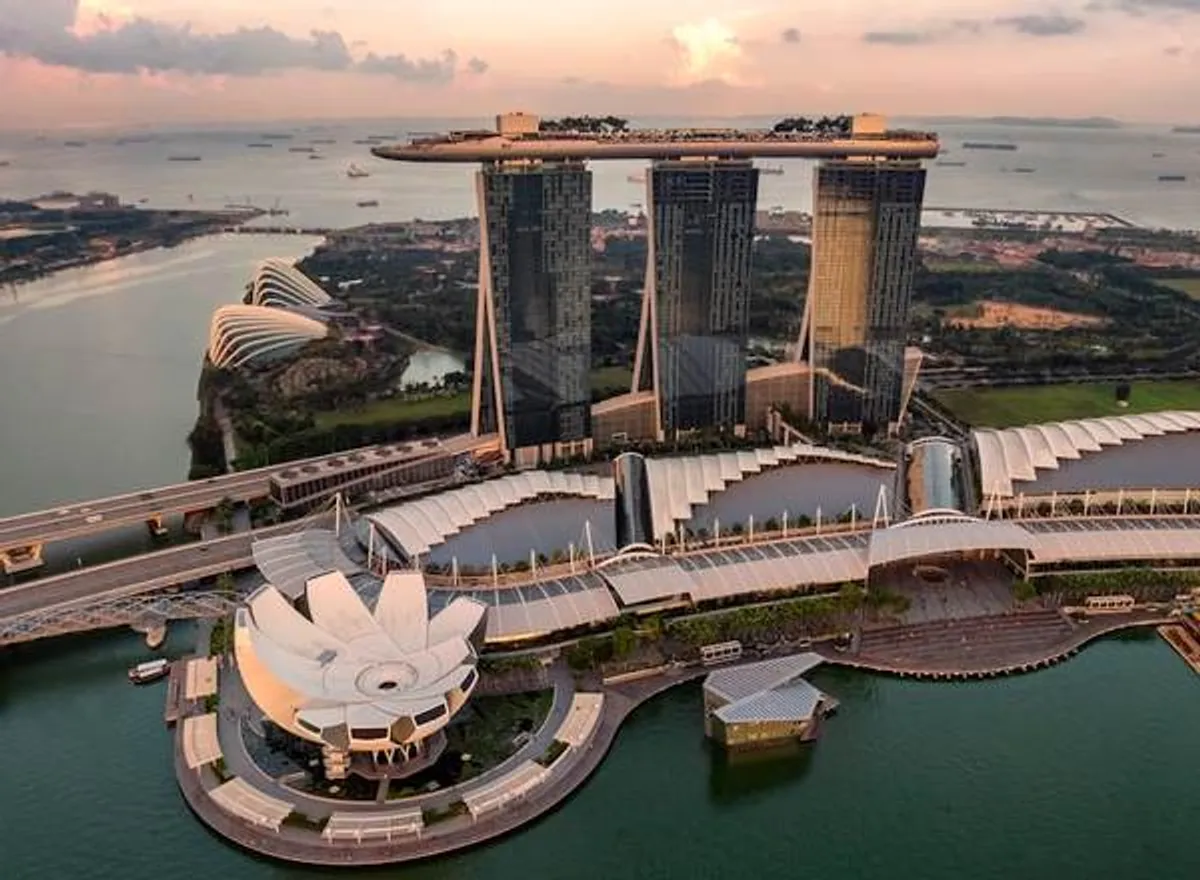
Start your Singapore experience at Marina Bay Sands — the iconic triple-tower resort with the boat-shaped SkyPark connecting all three towers 57 floors up. Non-guests can access the SkyPark Observation Deck for S$30 (approximately €20) and the view of the city skyline, the financial district glass towers, and the Gardens by the Bay canopies is genuinely jaw-dropping. Go in the morning before heat peaks and before the tourist crowds thicken.
The Shoppes at Marina Bay Sands below is one of Asia’s grandest luxury malls — if only for the indoor gondola canal, worth a 15-minute circuit.
Late Morning: Merlion Park & Financial District Walk
Walk along the waterfront promenade from the Sands toward the Merlion Park — the fountain-statue hybrid that has become Singapore’s most reproduced image is more modest in person than in photographs, but the surrounding esplanade and views back across the bay toward the Sands are beautiful. The colonial civic district just behind — City Hall, St Andrew’s Cathedral, the Asian Civilisations Museum — provides good material for 30–45 minutes of wandering.
Lunch: Chinatown
Take the MRT to Chinatown station for lunch. Maxwell Food Centre on Maxwell Road is the most famous hawker centre in Singapore for good reason — Tian Tian Hainanese Chicken Rice (stall 10/11) has been drawing queues for decades. Expect to wait 20–30 minutes, but the poached chicken and fragrant rice is worth it. A full meal costs S$7–S$10. Other reliable options at Maxwell: the satay stalls, the char kway teow, and the homemade tofu.
After lunch, walk around Chinatown’s temple streets — Sri Mariamman Temple (the oldest Hindu temple in Singapore, on South Bridge Road) and the Buddha Tooth Relic Temple on Maitland Road are both worth stepping inside.
Afternoon: Gardens by the Bay
Singapore’s most ambitious urban green space project, Gardens by the Bay is a 101-hectare reclaimed land park on Marina Bay’s eastern shore that opened in 2012 and has only become more impressive since. The two major climate-controlled domes — the Flower Dome (the world’s largest glass greenhouse) and the Cloud Forest (an extraordinary indoor mountain waterfall structure) — are worth visiting (combined ticket approximately S$40/€28). But equally compelling is simply walking around the outdoor gardens for free and watching the Supertrees — 25–50-metre vertical gardens — cycle through their daily show.
Evening: Supertree Grove Light Show
Come back to the Supertrees after dark for the Garden Rhapsody sound and light show (free, runs twice nightly at 7:45pm and 8:45pm). The illuminated trees and the reflection across the adjacent pond create one of the most spectacular urban spectacles in Asia. This is the definitive first-night Singapore experience.
Dinner afterwards at The Satay by the Bay outdoor hawker area (within the Gardens, cheaper than the adjacent restaurants) or at one of the restaurants along Marina Bay South Promenade.
Day 2: Sentosa Island, Orchard Road & Little India
Morning: Sentosa Island
Singapore’s island resort precinct is a curious mixture of world-class attractions and cheerful kitsch — take it on its own terms and you’ll have a fine morning. The easiest access is via the Sentosa Express monorail from VivoCity mall (S$4 round trip). Key draws:
- Universal Studios Singapore — A full day on its own; if you’re going, start here early and book tickets online in advance (approximately S$100/€70 for adults in 2026)
- Palawan Beach & Siloso Beach — Singapore’s only beachside experience; clean, well-maintained, family-friendly
- S.E.A. Aquarium — One of the largest aquariums in the world; excellent for an hour or two
If Universal Studios isn’t on the agenda, a morning at Sentosa’s beaches with a walk along the Boardwalk back to VivoCity (a scenic 20-minute route) is a pleasant, low-key alternative.
Afternoon: Orchard Road & the malls
Return to the city and explore Orchard Road, Singapore’s famous retail corridor — less essential for shopping now that most luxury brands are also at Marina Bay, but the sheer density of air-conditioned malls (ION Orchard, Paragon, 313@Somerset, Takashimaya) is extraordinary. The basement food halls of ION Orchard are worth exploring for afternoon snacks.
Late Afternoon: Little India
From Orchard Road, take the MRT to Little India for the late afternoon. The neighbourhood around Serangoon Road and Campbell Lane is one of Singapore’s most atmospheric — dense, colourful, and smelling richly of incense, jasmine garlands, and spices. Sri Veeramakaliamman Temple on Serangoon Road is among the most ornate Hindu temples in Southeast Asia. Mustafa Centre (a 24-hour hypermarket on Syed Alwi Road) is chaotic and marvellous — great for cheap Indian snacks, spices, and the widest currency exchange selection in Singapore.
Evening: Dinner in Little India
The streets around Tekka Centre and Race Course Road have excellent Tamil and North Indian restaurants. Komala Vilas on Serangoon Road (vegetarian South Indian, S$8–S$15) has been feeding Singapore since 1947. For a grander Tamil Nadu feast, Muthu’s Curry on Race Course Road (S$20–S$35/person) is famous for its fish head curry.
Day 3: Clarke Quay, Kampong Glam & Rooftop Bars
Morning: Clarke Quay & the Singapore River
The Singapore River quayside, particularly the stretch around Clarke Quay and Boat Quay, is best seen in the morning light before it transforms into Singapore’s most popular bar district after dark. Explore on foot from the Read Bridge southward — the restored shophouses on either bank are colourful and photogenic. The National Museum of Singapore (free entry to permanent galleries, on Stamford Road) is excellent if you want cultural depth; the exhibition on Singapore’s history from trading port to modern city-state is one of the best museum presentations in the region.
Late Morning: Kampong Glam (Arab Street)
Walk or take the MRT to Kampong Glam — Singapore’s Malay-Muslim quarter, centred on Sultan Mosque and the streets of Arab Street and Haji Lane. Sultan Mosque (Masjid Sultan) on North Bridge Road is a magnificent 1924 structure with a gold dome; non-Muslims can enter outside prayer times. The surrounding streets are excellent for independent boutiques, Middle Eastern restaurants, and Batik fabric shops. Haji Lane — a narrow lane one block behind Arab Street — is packed with indie cafés and fashion boutiques and is one of the most photographed streets in Singapore.
Lunch: Tekka Centre or Zam Zam
For lunch: Zam Zam on North Bridge Road (Muslim Indian, known for its mutton murtabak — a stuffed, pan-fried flatbread — for S$8–S$12) has been trading since 1908. Or head to nearby Tekka Centre for the hawker stalls on the ground floor.
Afternoon: National Gallery Singapore
Walk to the National Gallery Singapore on St Andrew’s Road — opened in 2015 within the restored Supreme Court and City Hall buildings, it holds the world’s largest public collection of Southeast Asian art. Free entry to the permanent galleries; temporary exhibitions vary. Allow 90 minutes to two hours for the permanent collection highlights.
Evening: Rooftop Bars
Singapore’s rooftop bar scene is exceptional, with the best properties competing for the most dramatic possible city and sea views. According to HaveNaGo, this is one of Singapore’s clearest strengths — the elevation of the entire experience by the city’s vertical drama.
Top picks for a sunset or evening drink:
- 1-Altitude (1 Raffles Place, 63rd floor) — The highest al fresco bar in the world; unmatched 360-degree views
- Lantern at Fullerton Bay Hotel — More intimate rooftop with beautiful bay views; excellent cocktails
- LeVeL33 (Marina Bay Financial Centre Tower 1, 33rd floor) — World’s highest urban craft brewery; great for beer lovers
- CÉ LA VI SkyBar (Marina Bay Sands, 57th floor) — The most famous; book ahead for tables, or queue for bar seating
Dinner before bars: Burnt Ends on Teck Lim Road (modern Australian BBQ, one Michelin star, S$80–S$140/person — book weeks ahead) or lau pa sat, the historic Victorian-era hawker centre on Raffles Quay (S$10–S$25, late-night satay after 7pm is the specialty).
Where to Stay
Singapore’s hotel scene is world-class but genuinely expensive by regional standards. The Marina Bay and Orchard Road areas are the most convenient; Chinatown and Bugis offer slightly lower rates with excellent MRT access.
Marina Bay Sands — The iconic Sands itself, with three towers, the infinity pool (guests only), and a casino, is a genuine experience. Rooms start at €280/night and peak significantly higher during Formula 1 (September) and New Year. Book at least six weeks ahead for best rates.
The Fullerton Hotel Singapore — The grand old dame of Singapore luxury hotels, occupying the restored 1928 General Post Office on Fullerton Square, directly on the Singapore River. The white neoclassical exterior and soaring lobby are extraordinary, and the location — between Boat Quay, Merlion Park, and the CBD — is unbeatable. The Fullerton Bay Hotel (a sister property on the waterfront) is more contemporary and slightly more expensive. Rates: €300–€500/night.
The Warehouse Hotel — A Design Hotels member in a converted 1895 riverfront godown (warehouse) on Robertson Quay, with 37 beautifully restored rooms and a swimming pool inside the original warehouse structure. Among the most atmospheric boutique stays in the city. Robertson Quay is a quieter, more residential stretch of the river than Clarke Quay — excellent restaurants within walking distance. Rates: €200–€340/night.
Hotel Jen Orchardgateway — A solid mid-range choice on Orchard Road, with a rooftop pool and reliable international-standard comforts. The Orchard MRT station is a few minutes’ walk. Rates: €120–€200/night.
Budget pick — ibis Singapore on Bencoolen — Reliable, well-located budget option near Bras Basah MRT, within walking distance of the Colonial District and Bugis. Rooms are small but clean and functional. Rates: €60–€100/night.
Practical Info
Visa: Singaporeans are among the world’s most generous visa providers — citizens of EU countries, the UK, US, Canada, Australia, Japan, South Korea, and dozens more enter visa-free for 30 days. Check the ICA website (ica.gov.sg) for the current list before travel.
Getting around — MRT: Singapore’s Mass Rapid Transit system is comprehensive, air-conditioned, and extremely reliable. It covers all major tourist areas. Buy an EZ-Link card (S$10, S$5 deposit + S$5 stored value) at any MRT station or 7-Eleven. Top up at station machines. Single journey fares range from S$0.90–S$2.50.
Getting from the airport: Changi Airport (SIN) is one of the world’s best airports — Terminal 3 to 5 are all connected, and the Jewel (the waterfall mall in the middle of Terminals 1–3) is worth time even in transit. The Airport MRT Line (East-West Line) runs directly to the city centre in 30–35 minutes for S$2.50. Taxis from the airport cost S$25–S$45 depending on destination and time.
Hawker centres explained: Singapore’s hawker centres are open-air or semi-enclosed food courts where individual stalls serve single dishes at S$3–S$12. They are not restaurants in the Western sense — you order from a stall, find a table (usually shared), and the stall delivers or you collect. The variety and quality is extraordinary. Major centres for tourists: Maxwell Food Centre, Lau Pa Sat, Newton Circus Food Centre, Old Airport Road Food Centre (the most authentic, favourite of locals).
Weather & packing: Singapore is hot (30–34°C) and humid year-round, with no distinct seasons. Afternoon thunderstorms are common, especially May–September. Pack light clothing, sunscreen, and a compact umbrella or rain jacket. Indoor spaces (malls, MRT, museums) are frequently over-air-conditioned — a light layer is useful.
FAQ
Is Singapore expensive? Yes — it’s one of the most expensive cities in Asia for accommodation and alcohol. But food costs are genuinely low at hawker centres (a full meal for S$8–S$12), public transport is cheap, and most major attractions are affordable. A mid-range 3-day trip (mid-range hotel, hawker meals, a few paid attractions) can be done for €150–€200/day per person.
How many days do I need in Singapore? Three days covers the essential sights without feeling rushed. Two days is tight but manageable if you prioritise well. Four or five days allows deeper neighbourhood exploration — Tiong Bahru (Singapore’s first public housing estate, now full of indie cafes), Joo Chiat (Peranakan culture), and Pulau Ubin (a rustic island accessible by bumboat, like Singapore 50 years ago).
What is the best hawker dish to try in Singapore? Hainanese Chicken Rice is the national dish by common consensus — poached or roasted chicken on fragrant rice, with chilli sauce and ginger paste. Also essential: laksa (spicy coconut noodle soup), char kway teow (wok-fried flat rice noodles with egg, Chinese sausage, and beansprouts), and chilli crab (expensive, messy, and wonderful — best at Long Beach or No Signboard Seafood).
Is Singapore safe? Singapore is consistently ranked among the safest cities in the world. Violent crime is extremely rare; petty crime is uncommon. The legal system is strict — littering, jaywalking, and consuming durian in public transport are genuinely fineable offences. Drug laws are extremely severe and widely publicised. Exercise the same common sense you would anywhere.