
Photo: Basile Morin / Wikimedia Commons
Seoul Travel Guide: Palaces, Street Food, K-Pop & Everything Between
The complete Seoul travel guide — Gyeongbokgung Palace, Bukchon Hanok Village, Korean BBQ, Myeongdong shopping, DMZ tours, transport tips, and the best time to visit South Korea's capital.
Seoul is a city of contrasts that somehow feels cohesive: ancient palaces surrounded by skyscrapers, Buddhist temples next to convenience stores open at 3am, centuries-old street food stalls beside Michelin-starred restaurants. With 10 million residents in the city proper and 26 million in the greater metropolitan area, Seoul is one of the world’s great megacities — and one of its most visitor-friendly.
Getting to Seoul and Around
Incheon International Airport (ICN) is consistently rated among the world’s best airports and handles the vast majority of international arrivals. The AREX (Airport Railroad Express) connects Incheon to Seoul Station in 43 minutes (all-stop service, ₩4,150/€2.80) or 51 minutes to Hongik University station. Taxis from the airport to central Seoul run ₩60,000–80,000 (€40–55) and take 45–90 minutes depending on traffic.
The T-money Card is the essential first purchase for any Seoul visitor. Rechargeable at convenience stores and subway stations, it works on the entire subway network, city buses, and many taxis, and gives a small per-ride discount over cash fares. Load it with ₩30,000–50,000 (€20–35) to start and top up as needed. Seoul’s subway is clean, safe, air-conditioned, and has English signage throughout — it is genuinely one of the world’s best urban transit systems.
Walking and cycling work well in many neighbourhoods. Seoul has an extensive bike-sharing system (Ttareungyi) with stations throughout the city and pleasant cycling paths along the Han River.
Palaces and Historical Sites
Gyeongbokgung Palace is the largest and most imposing of Seoul’s Five Grand Palaces, built in 1395 by the Joseon Dynasty. The hourly Changing of the Royal Guard ceremony at the Gwanghwamun Gate is free to watch and draws large crowds. Admission is ₩3,000 (€2) for adults; free on the first Sunday of each month. Rent a hanbok (traditional Korean dress, ₩15,000–25,000/hour) from the shops on Gyeongbokgung-ro to enter for free and for an unmissable photo experience. Go early — by 10am in summer the palace fills rapidly.
Changdeokgung Palace and the Secret Garden is often considered the most beautiful of Seoul’s palaces, and UNESCO agrees — it is a World Heritage Site. The rear garden (Huwon) must be visited on a guided tour; book online well in advance for the English-language tour (runs three to four times daily, ₩8,000/adult). The garden design integrates Confucian principles with natural topography in a way that remains genuinely stunning.
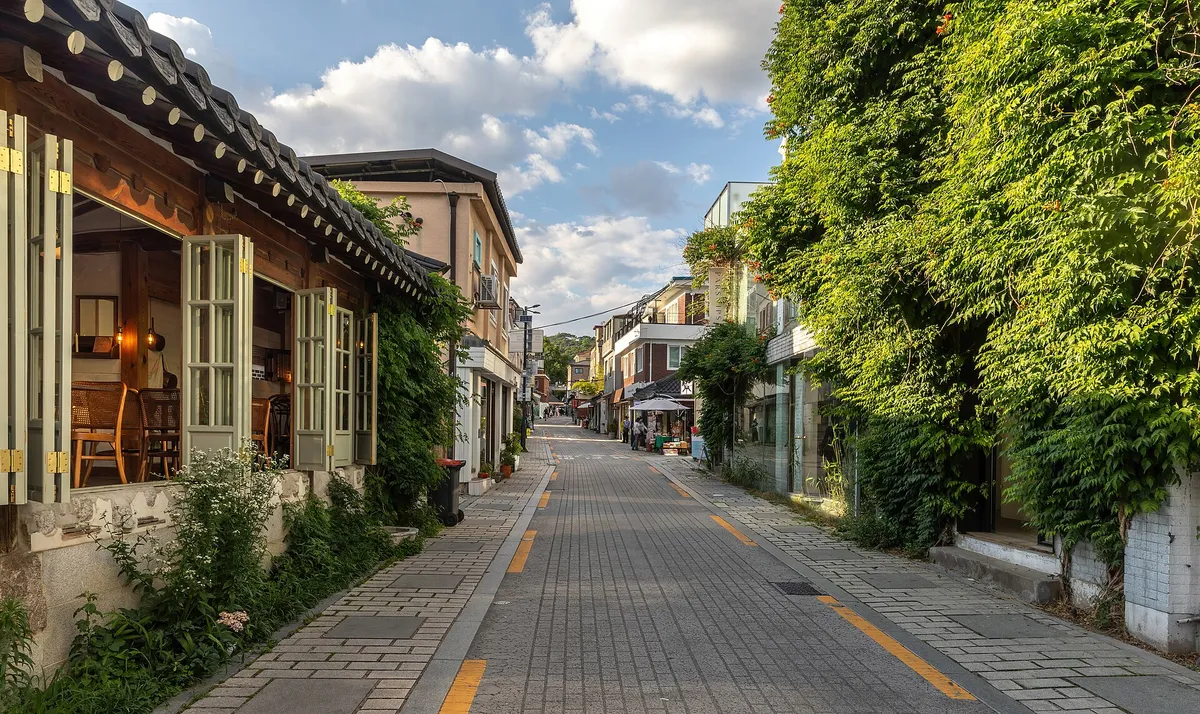
Bukchon Hanok Village sits between Gyeongbokgung and Changdeokgung Palaces, a neighbourhood of preserved hanok (traditional Korean wooden houses) that provides the most photogenic streetscapes in Seoul. The village is a living neighbourhood, not a museum — residents have pushed back against tourist behaviour (noise, entering private areas), so the city now limits visiting hours to 10am–5pm on weekdays and 10am–3pm on weekends. Be respectful, keep noise low, and stay on the marked paths.
Insadong is the arts and antiques district immediately south of Bukchon, a pedestrianised street and network of alleys packed with tea houses, craft galleries, Korean pottery shops, and street food vendors selling hotteok (sweet filled pancakes). The main pedestrian street on Sundays draws artists and live performers. It is the best area in Seoul for buying genuine Korean crafts.
Modern Seoul
Myeongdong is Seoul’s Times Square equivalent — a dense shopping district of Korean cosmetics brands (Innisfree, Etude House, Sulwhasoo), international fashion retailers, and street food vendors who set up from around 5pm. Korean beauty (K-beauty) shopping is a primary reason many visitors come to Seoul specifically; prices are significantly cheaper than the same brands sold internationally. The street food corridor running through Myeongdong is excellent: tteokbokki (spicy rice cakes), kimbap (seaweed rice rolls), tornado potatoes, and egg bread.
Gangnam (south of the Han River) is the upscale district made globally famous by Psy’s 2012 song. COEX Mall is one of the world’s largest underground shopping malls. Apgujeong Rodeo Street is Seoul’s luxury fashion corridor. The neighbourhood is polished and expensive compared to central Seoul — worth a half-day visit to understand the full range of the city, but not the most characterful area for visitors.
Hongdae (Hongik University district) is the youth culture and nightlife hub, packed with indie music venues, dance clubs, vintage shops, and street performers. The weekend free market (Fri–Sun afternoons) is a good place to find local art and fashion. The area east towards Mapo-gu has excellent coffee shops and the kind of independent restaurant scene that escapes the guidebooks.
Korean BBQ and Street Food
Korean BBQ — grilling marinated beef, pork belly (samgyeopsal), or chicken at a table-mounted grill — is the essential Seoul meal. For first-timers, the best experience is at a dedicated meat restaurant where the server grills for you. Maple Tree House and Maple House are mid-range and tourist-accessible; for local authenticity, find a spot in Mapo-gu or Yeongdeungpo with photos on the menu and walk in.
Tteokbokki (spicy rice cakes in gochujang sauce) is Seoul’s quintessential street food, sold everywhere from ₩3,000–5,000 a portion. Kimbap (seaweed rolls similar to but distinct from Japanese sushi) makes an excellent cheap meal or snack at ₩2,000–4,000. Sundae (blood sausage, very traditional and polarising) is worth trying at Gwangjang Market, the city’s most atmospheric traditional market, where vendor stalls have operated for over a century.
K-Pop Culture
Seoul is the global capital of K-Pop and the fan pilgrimage infrastructure has grown accordingly. SM Town (COEX), Big Hit Music (Yongsan), and JYP Entertainment buildings are all photographed by fans. The Hybe Insight Museum (WeVerse Square, Yongsan) is an immersive exhibition on the company behind BTS and other acts; book tickets online weeks ahead. Weekly music show recordings (Inkigayo, Music Bank, M Countdown) admit audiences, sometimes for free, with registration on the show’s official website or via Weverse.
DMZ Day Trip
The Demilitarized Zone between North and South Korea, 55km north of Seoul, is one of the world’s most compelling geopolitical sites. Independent visits are not permitted — you must join an authorised tour. Several operators run full-day tours from Seoul for ₩50,000–90,000 per person including transport and guide. Highlights include the Joint Security Area (JSA) at Panmunjom (requires separate booking due to capacity limits), infiltration tunnels dug by North Korea, and Dora Observatory overlooking North Korean territory. Bring your passport.
Best Time to Visit Seoul
April to May is the most popular time to visit: cherry blossoms bloom across the city (typically late March to mid-April), temperatures are pleasant (12–22°C), and spring festivals run throughout. Book accommodation months ahead for cherry blossom peak.
September to October offers warm, dry weather and vivid autumn colours, particularly striking in the palace gardens and the forested areas of Bukhansan National Park north of the city.
June to August is hot (27–35°C) and humid, with monsoon rains in July. Not the most comfortable time but useful for budget travellers as accommodation prices drop slightly.
December to February is cold (below freezing, occasional snow) but manageable, and the ski resorts within two hours of Seoul (Vivaldi Park, Bears Town) offer a different experience of South Korea.
Budget and Costs
Seoul is more affordable than Tokyo or Singapore for visitors. A hostel dorm costs ₩15,000–25,000 (€10–17); a private room at a guesthouse or budget hotel runs ₩50,000–90,000 (€35–62). Street food meals cost ₩3,000–8,000; sit-down Korean restaurants ₩10,000–20,000 per person. The subway never charges more than ₩2,300 (€1.60) for a single journey. A comfortable daily budget is €50–80 including accommodation.
Currency: South Korean Won (KRW). ATMs at 7-Eleven and GS25 convenience stores (both of which are everywhere) reliably accept foreign cards. Inform your bank before travelling.
Havenago is an independent travel guide. Prices reflect publicly available data from July 2026.