
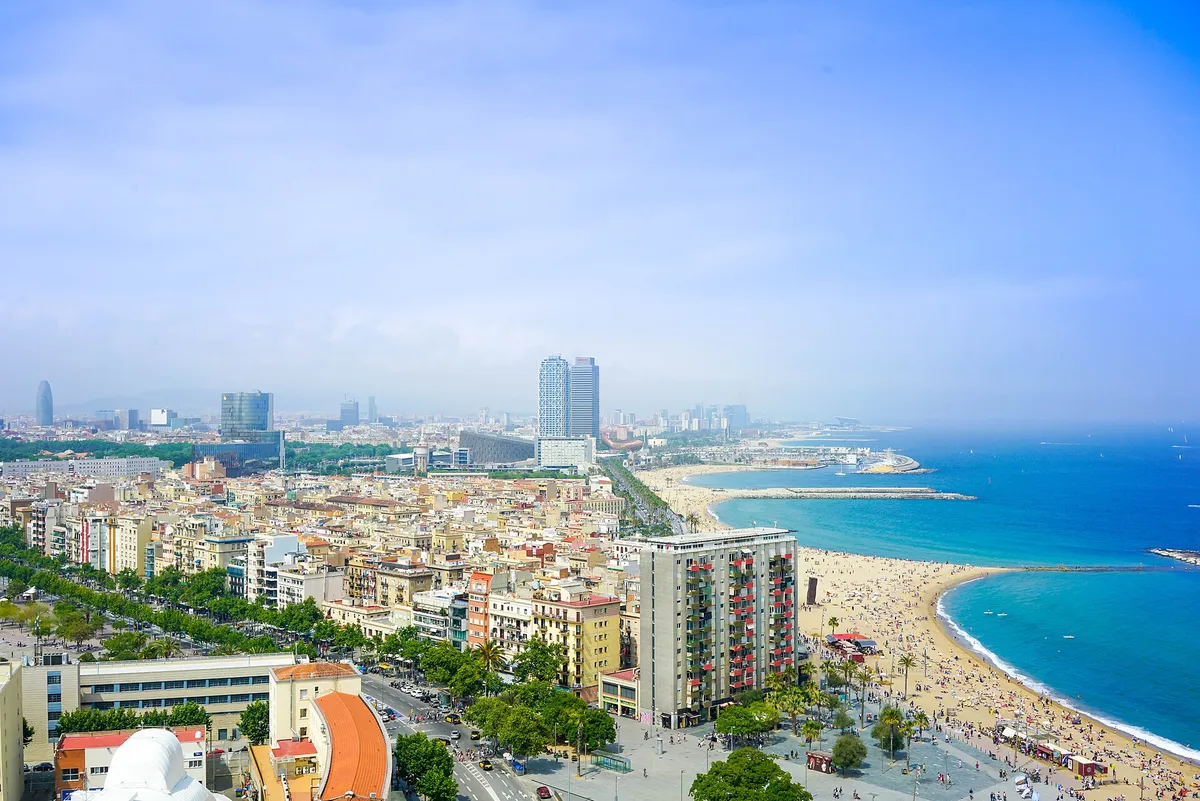
Photo: Enes royalfound / Wikimedia Commons
Best Time to Visit Spain: Month-by-Month Guide for Barcelona, Madrid & Seville
April and October bring Spain's mildest weather — the Feria de Abril in Seville, and golden autumn light over Barcelona. The complete month-by-month guide for 2026.
Spain’s Travel Seasons
Spain spans two fundamentally different climate zones — the Atlantic northwest (Galicia, the Basque Country: temperate, wet, green year-round) and the Mediterranean-interior (Barcelona, Madrid, Seville: hot dry summers, mild winters). This guide focuses on the major Mediterranean cities.
| Month | Barcelona | Madrid | Seville | Verdict |
|---|---|---|---|---|
| January | 13°C | 7°C | 15°C | Quiet, cheap, good for museums |
| February | 14°C | 9°C | 16°C | Good; Carnival in Cádiz |
| March | 16°C | 11°C | 18°C | Very good; Fallas in Valencia |
| April | 18°C | 15°C | 22°C | Best month (Seville Feria) |
| May | 21°C | 19°C | 26°C | Excellent |
| June | 25°C | 25°C | 32°C | Good (Barcelona better than inland) |
| July | 28°C | 31°C | 38°C | Avoid Madrid/Seville; Barcelona OK |
| August | 28°C | 30°C | 38°C | Peak crowds; Madrid and Seville difficult |
| September | 26°C | 26°C | 30°C | Very good (coast still warm) |
| October | 22°C | 20°C | 24°C | Excellent |
| November | 17°C | 13°C | 19°C | Good; quiet |
| December | 14°C | 8°C | 15°C | Christmas lights, Christmas markets |
The Best Time by City
Barcelona
Best: May–June and September–October. Barcelona’s climate is Mediterranean coast — the sea moderates the summer heat (27–29°C in July is warm but significantly less extreme than inland Madrid or Seville). The combination of beach, architecture (Gaudí, the Gothic Quarter, the Eixample), and food culture works year-round, but the outdoor culture (the Barceloneta beach, the rooftop bars, the terrace restaurants) is at its best in mild weather.
April–June: Spring is Barcelona’s sweet spot — the city’s celebrated food scene (Tickets, Enigma, Casa Lleopoldo, Cinc Sentits) is accessible without the 2-month booking window required in summer; the Gaudí sites (Sagrada Família, Park Güell) have shorter queues than July–August; the Barceloneta beach is swimmable from May and relatively uncrowded.
July–August: Barcelona in summer is genuinely good (the Mediterranean sea at 24–27°C, the beach culture, the outdoor festivals including Sónar — the most important electronic music festival in Europe) but requires maximum advance booking — the Sagrada Família, Park Güell, and Casa Batlló require booking 3–6 weeks ahead in peak season.
September: Arguably Barcelona’s best all-round month — the Mercè festival (Barcelona’s main city festival, the third week of September: free concerts, human towers (castellers), the Piromusical fireworks display over the Barceloneta breakwater; the largest urban festival in Spain outside Seville’s Feria) coincides with warm, dry weather, the post-summer crowd reduction, and soft golden autumn light.
Madrid
Best: April–June and September–October. Madrid is an interior city (650 meters altitude on the Meseta) — the continental climate means temperatures are extreme in both directions (38–42°C in July, 3–8°C in January, with genuine snow some winters). The spring and autumn windows are genuinely the only comfortable seasons for extensive outdoor Madrid exploration.
Cultural tourism year-round: Madrid’s museum trio (the Prado — the greatest collection of Spanish painting in the world, with Velázquez, Goya, El Greco, Bosch; the Reina Sofía — with Guernica, Picasso’s Spanish Civil War masterpiece; the Thyssen-Bornemisza — one of the world’s great private collections, spanning Duccio to Hockney) operates year-round and is best in winter or early spring when the queue pressure is lowest.
Summer evenings: Madrid’s famous madrugada culture (the late-night café and restaurant culture — dinner at 22:00, bars open until 05:00) is a genuine experience that can compensate for the daytime heat in summer. The city’s lively tapas scene (La Latina neighborhood, the Cava Baja and surrounding streets) is at its most accessible in June and September.
Seville
Best: March–April and October–November. Seville has Spain’s most extreme climate — the hottest major city in Western Europe (42–46°C days in July and August are not uncommon; the 2021 heat wave reached 47.4°C). The spring and autumn windows are genuinely the only times for outdoor Seville — and spring is when the city truly comes alive.
Semana Santa (Holy Week, March/April): The most spectacular religious procession event in Europe — the 60+ Seville brotherhoods (cofradías) carry their intricately carved floats (pasos — some weighing 5 tonnes, carried by 50+ bearers hidden beneath the float) through the streets of Seville over 6 days (Palm Sunday to Easter Sunday). The combination of the elaborate Baroque floats, the penitential music (marching bands playing marchas procesionales), and the intense religious fervor of the crowd makes this one of the most powerful public events in Spain.
Feria de Abril (April–May): Two weeks after Easter, Seville’s Feria (April Fair) transforms the Triana area into a city of casetas (decorated tent-pavilions) — thousands of Sevillanos turn out in traditional dress (men in traje corto, women in traje de gitana flamenco dresses), alongside horse-drawn carriages, fino sherry, and flamenco dancing. The Feria de Abril ranks among Spain’s biggest annual festivals.
Major Events and Festivals
Las Fallas, Valencia (March 13–19): This Valencian festival is unlike anything else in Spain — enormous satirical sculptures (fallas, constructed from papier-mâché and wood, some 10+ meters tall) are erected throughout the city over months of preparation, then burned simultaneously at midnight on March 19 (La Cremà). The sound of 24-hour fireworks for an entire week is the most explosive festival experience in Europe.
Semana Santa throughout Spain (March/April): Not only Seville — the Holy Week processions in Málaga, Valladolid, Zamora, and Granada are each remarkable in their own way. Zamora (Castilla y León) has the most austere and most ancient processions; Málaga’s are the most theatrical.
San Fermín, Pamplona (July 6–14): The Running of the Bulls (the encierro) — the world’s most famous festival risk activity. The 825-meter morning run (06:30–06:40 if no incidents, longer if bulls are separated) involves 2,000+ runners and 6 fighting bulls. Deaths are rare but injuries are annual. The festival itself (concerts, fireworks, bars open continuously) is a cultural spectacle in its own right, regardless of whether you run.
La Tomatina, Buñol (Last Wednesday of August): The world’s largest food fight — 120 tonnes of tomatoes hurled between 20,000 participants over one hour. The small town of Buñol (40 minutes from Valencia) hosts what has become one of Europe’s most photographed events. Purely experiential rather than culturally substantive.
La Mercè, Barcelona (Late September): Spain’s biggest urban festival after Seville’s Feria — free concerts at 50+ venues throughout the city, the Piromusical (the Barceloneta synchronized fireworks and music display, 30 minutes, Barcelona’s best free event), the castellers (human tower competitions in the Plaça de Sant Jaume), and the correfoc (fire-running with devil costumes and fireworks).
City-Specific Practical Notes
Barcelona booking windows:
- Sagrada Família: book 3–6 weeks ahead in peak season, 1 week ahead in spring/autumn
- Park Güell (the ticketed Dragon Staircase area): book 2 weeks ahead in summer
- Casa Batlló: book 1–2 weeks ahead year-round
- Restaurant reservations: Tickets (June–September minimum 2 months) vs. December–March (2 weeks)
Madrid: The Prado, Reina Sofía, and Thyssen-Bornemisza are all bookable online with time-slots — queue times vary from 0 (January mornings) to 45 minutes (July–August Saturday afternoons). The Thyssen is the most undervisited of the three and the most bookable year-round.
Seville: The Real Alcázar (the stunning Mudéjar palace — among the most beautiful buildings in Spain) has timed entry — book 2–4 weeks ahead in April (Feria period) and September–October. The Catedral de Sevilla (the third largest cathedral in the world) and the Giralda tower require 30–60 minute queues or advance booking.
FAQ
What is the best month to visit Spain overall? April — the combination of mild weather throughout the country (not yet hot enough for discomfort, the Mediterranean sea beginning to warm), the dramatic Semana Santa and Feria de Abril if visiting Seville, and the spring wildflowers on the meseta and in the Pyrenean foothills make April the best all-round choice for first-time visitors.
When is Spain too hot to visit? Madrid and Seville in July–August are genuinely too hot for comfortable outdoor tourism (38–46°C). The coast (Barcelona, San Sebastián, Málaga) has the sea moderating to 27–32°C in July, which is tolerable but still hot. For travelers sensitive to heat, Spain’s tourist season ideally ends in June and resumes in September.
Is the Basque Country worth including? Yes — the Basque Country (San Sebastián and Bilbao) has a year-round moderate Atlantic climate (18–24°C in summer, 10–15°C in winter — never extreme in either direction), the world’s highest concentration of Michelin-starred restaurants per capita (San Sebastián has the most Michelin stars per person of any city in the world), and the striking Guggenheim Bilbao (the Frank Gehry titanium-clad building, 1997, arguably the most important single building of the late 20th century). The Basque Country can be visited most comfortably in May–October, with October being excellent for the gastronomic festivals.