
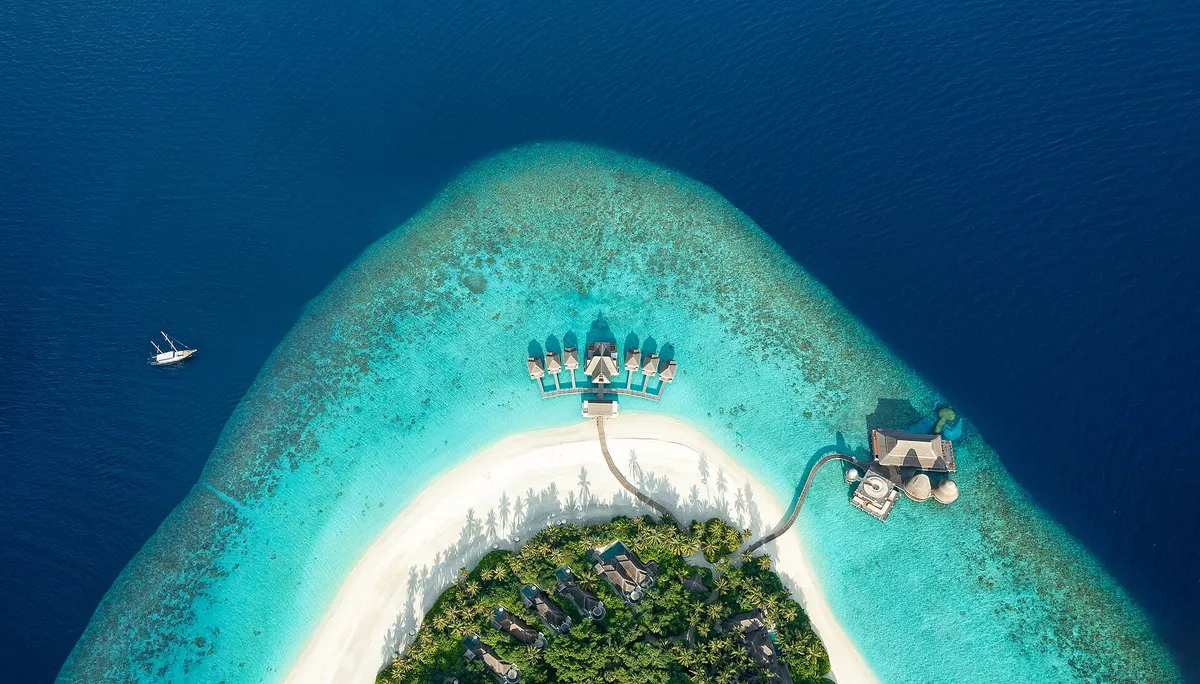
Photo: Matheenfaiz / Wikimedia Commons
Best Maldives Overwater Villas: Which Resort Is Right for You? (2026)
Soneva Fushi's barefoot luxury, Gili Lankanfushi's treehouse-style overwater bungalows, and the North Malé Atoll's accessible splurge resorts — choosing the right Maldives hotel for your trip in 2026.
Choosing a Maldives Resort: The Real Decision
The Maldives has 160+ resort islands, and each one is its own island — resort and island are synonymous here, with no public beaches or multi-resort islands in the main tourist zone. The choice between resorts is genuinely complicated: seaplane versus speedboat access, house reef quality, villa style (overwater versus beach), dining quality, and the geography of the specific atoll all vary a great deal.
This guide lays out the real framework for choosing.
The Access Distinction
Seaplane access (Malé’s seaplane terminal → resort): The seaplane flight itself — 15 to 45 minutes over the turquoise atoll landscape — is one of the better transport experiences in travel: the reef seen from 500 meters, the shifting colors of the lagoon, the landing at the resort jetty. Seaplane resorts sit mostly in the outer atolls, further from Malé airport, and typically require an overnight stay at an airport hotel before or after early-morning or late-evening flights, since seaplanes only operate in daylight (roughly 06:00–17:00).
Speedboat access (Malé → resort, 20–45 minutes): North Malé Atoll resorts reachable by speedboat — Baros, Coco Bodu Hithi, One&Only Reethi Rah, Four Seasons Landaa Giraavaru — skip the seaplane logistics entirely and are reachable from the airport at any hour, day or night. It’s more convenient, though these atolls can feel slightly less remote.
The Finest Resorts by Category
The Standout Resort: Soneva Fushi (Baa Atoll)
Price: $2,000–25,000/night | Access: Seaplane 40 minutes
Soneva Fushi is widely considered the standout resort in the Maldives by critical consensus. Founder Sonu Shivdasani created the original “barefoot luxury” template here in 1995, and the resort still runs on its “Mr Friday” system — a dedicated, 24-hour butler assigned to each villa who manages every part of the stay. The island itself carries the heaviest natural vegetation cover of any Maldivian resort: ancient trees and dense tropical forest that feel like genuine jungle despite the five-star infrastructure underneath. Two things are unique to Soneva Fushi: its observatory, with a dedicated telescope and resident astronomer taking advantage of the Baa Atoll’s near-total absence of light pollution, and Cinema Paradiso, its outdoor underwater cinema.
The surrounding Baa Atoll UNESCO Biosphere Reserve, which includes Soneva Fushi’s house reef, is home to some of the world’s best manta ray snorkeling. Hanifaru Bay, 30 minutes away by boat, sees aggregations of 200+ manta rays feeding during the plankton-rich monsoon season (May–November).
Best Overwater Architecture: Gili Lankanfushi (North Malé Atoll)
Price: $1,500–12,000/night | Access: Speedboat 20 minutes
Gili Lankanfushi is the most architecturally distinctive resort in the Maldives — overwater bungalows built on stilts, with a “crusoe” design of thatched roofs, timber decks, and glass floor panels that let the coral and fish below show through. It runs its own version of the “Mr Friday” butler concept, modeled on Soneva’s, and holds firmly to a “no shoes, no news, no clocks” philosophy: there are genuinely no newspapers, televisions, or clocks in the rooms, making it about as complete a digital detox as the Maldives offers.
Most Beautiful Lagoon: Baros Maldives (North Malé Atoll)
Price: $800–4,000/night | Access: Speedboat 25 minutes
Baros has arguably the best lagoon of any Maldivian resort — a particular depth and composition of water that photographs a more vivid turquoise than most other properties manage. The house reef is excellent and reachable directly from the beach without a boat, and the Lighthouse Restaurant, set on a platform at the end of a long jetty with 360° lagoon views, is one of the most beautifully positioned dining rooms in the country. Baros is also notable for being one of the more accessible luxury resorts at a relatively low price point, helped by its speedboat access.
Best Value: Coco Bodu Hithi (North Malé Atoll)
Price: $600–3,000/night | Access: Speedboat 30 minutes
Coco Bodu Hithi delivers a strong Maldivian resort experience at a comparatively reasonable price — its overwater residence villas are some of the best-designed at this price tier, the house reef is excellent, there are multiple restaurants, and the service consistently exceeds what the rates would suggest. Speedboat access adds a further convenience.
Most Private: Four Seasons Landaa Giraavaru (Baa Atoll)
Price: $2,500–20,000/night | Access: Seaplane 35 minutes
Four Seasons Landaa Giraavaru is the most private of the major Maldivian luxury resorts, set in a jungle landscape with one of the largest natural vegetation covers in the country outside Soneva Fushi. Diving here benefits from the Baa Atoll UNESCO Biosphere, among the best diving grounds in the Maldives, and guests have access to the Four Seasons Explorer, a private three-deck liveaboard yacht for multi-day island and dive trips through the atoll.
Understanding Maldives Villa Types
Overwater Villas
The defining Maldivian accommodation format: villas on stilts over the lagoon, the water visible through glass floor panels, steps leading directly from the deck into the sea, and an uninterrupted ocean horizon from the private sun deck. The views from Gili Lankanfushi, Soneva Fushi’s overwater villas, and Baros’s overwater rooms are as good as this format gets.
The premium: Overwater villas typically cost 40–60% more than beach villas at the same resort. Is it worth it? For honeymooners and couples on a once-in-a-decade trip, generally yes. For families with children who’ll spend most of their time in the pool and on the beach rather than on the villa deck, a beach villa provides more usable space for less money.
Beach Villas
The traditional Maldivian alternative: a villa directly on the beach, with the ocean visible from the garden terrace. Beach villas offer more outdoor space and direct sand access, and house reef snorkeling from the beach is often better than from an overwater villa, since overwater villas sit out over the lagoon, away from the reef edge itself. Soneva Fushi’s jungle beach villas and Baros’s beach villas rank among the most beautiful rooms at any resort worldwide.
Maldives Practical Notes
The “all-inclusive” question: Full-board Maldives packages — all meals and non-alcoholic drinks included — are typically excellent value once you factor in the speedboat and seaplane transfer fees, the quality of dining across all meals, and included activities like snorkeling, kayaking, and windsurfing at most resorts. Alcohol and spa treatments are almost always billed separately.
The best months to visit: November–April is the dry season, bringing the clearest water for snorkeling and diving (30m+ visibility) and the calmest seas — important for overwater villas, since swell can make them uncomfortable on the more exposed atolls. May–October is the wet, green monsoon season: the Baa Atoll’s manta ray season peaks in June–August, prices drop 20–30%, and the lagoon stays swimmable even as visibility drops somewhat.
FAQ
Is the Maldives overrated? No — the core experience, a turquoise lagoon, an overwater villa, coral and fish visible directly through the deck’s glass floor panels, isn’t replicated anywhere else at this scale. What can be overstated is the cultural experience: Maldivian resort islands are deliberately designed as isolated getaways, so travelers wanting cultural immersion alongside natural beauty often pair the trip with Sri Lanka or a few days in Singapore.
What is the minimum stay for the Maldives? Four nights is the practical minimum, given seaplane logistics where applicable, time zone adjustment, and the overall cost of the trip — a 3-night stay tends to feel too brief. Seven nights is closer to ideal: a day for arrival, four days for the resort itself, and two more for extras like a sandbar picnic, a sunset dolphin cruise, or a bioluminescent-plankton night snorkel.
Which is better: overwater villa or beach villa? For couples and honeymooners, the overwater villa — waking up over the ocean is the quintessential Maldivian moment. For families with children, the beach villa — garden space, direct beach access for building sandcastles, and a lower price point, since kids tend to care less about an overwater deck than adults do.