
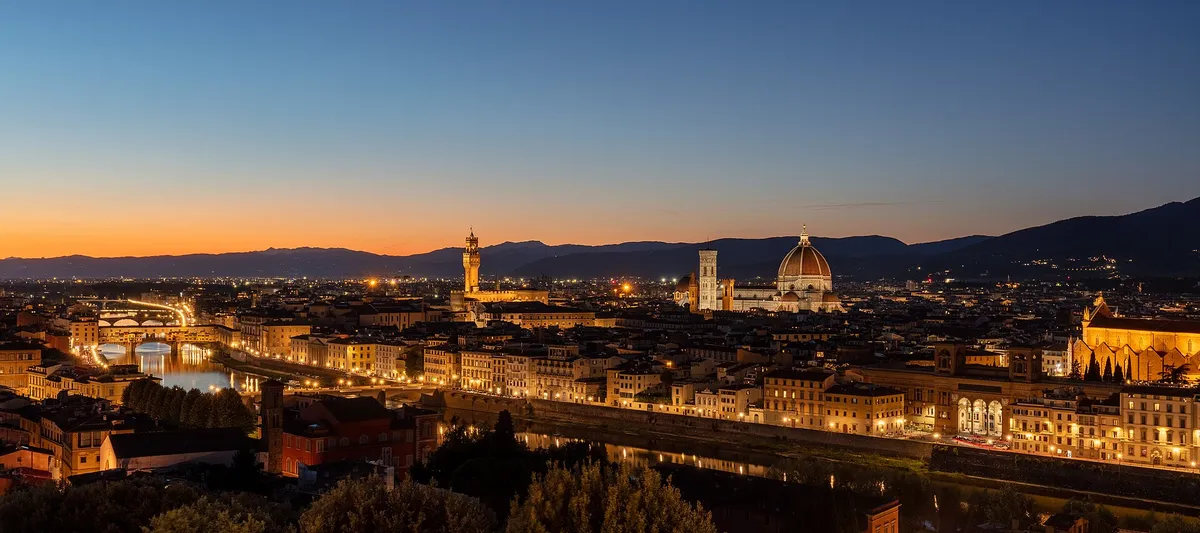
Photo: Diego Delso / Wikimedia Commons
Best Hotels in Florence: Oltrarno, Lungarno & the Piazza Signoria (2026)
Belmond Villa San Michele's hillside Michelangelo façade above Fiesole, the Portrait Firenze's Arno river family townhouse, and Hotel Savoy's Piazza della Repubblica palazzo — Florence's finest hotels near the Uffizi and Duomo in 2026.
Florence: The Hotel Capital of the Renaissance
No hotel city in Europe is as culturally concentrated as Florence, the most important art city in the world. The Uffizi Gallery holds what many consider the greatest painting collection anywhere: Botticelli’s Birth of Venus and Primavera — the two defining paintings of the Renaissance and the most reproduced works in Italian art history — alongside Leonardo da Vinci’s Annunciation and Caravaggio’s Medusa. The Accademia Gallery has Michelangelo’s David, the most visited single sculpture in the world: a 5.17m marble figure carved between 1501 and 1504, and the most famous artwork in Italy — book 3–4 weeks minimum for the August–October peak, the single most important advance booking in Florence. And the Duomo carries Brunelleschi’s dome, the defining architectural achievement of the Renaissance: completed in 1436, it solved the greatest engineering problem of 15th-century Europe, and the 463 steps to the drum reward you with the best architectural view on the continent — the Florence cityscape, the terracotta rooftops, and the Tuscan hills in every direction.
Fiesole Hills — The Michelangelo View
Belmond Villa San Michele — Michelangelo’s Façade
Price: €500–3,500/night | Location: Via Doccia 4, Fiesole (Florence Hills)
Belmond Villa San Michele is the most celebrated hotel in Tuscany, and its Fiesole hillside position gives it a claim to the best hotel view in Italy. The monastery villa sits 450m above the Arno Valley, with the most comprehensive Florence panorama available from any hotel — the Duomo, the Campanile, the Palazzo Vecchio, and the Ponte Vecchio all simultaneously visible across 180 degrees. Then there is the Michelangelo connection: the 15th-century monastery façade is attributed to him — the best-known attribution dispute in architectural history, making the loggia façade of the San Michele monastery Italy’s best-known “possibly Michelangelo” building.
The colonnaded Renaissance loggia may be the loveliest hotel outdoor space in Italy; a candlelit dinner there, with the Brunelleschi dome glowing across the valley over a glass of Tuscan wine, is as romantic as dining in this country gets. The outdoor pool shares the Florence panorama — among hotel pool views in Italy, only the Amalfi Coast competes — and the 15th-century chapel, with frescoed walls and marble floor, is Italy’s most sought-after hotel wedding venue: a Villa San Michele chapel ceremony is the most photographed wedding in Tuscany.
Lungarno — The Arno Riverside
Portrait Firenze — The Ferragamo Riverside
Price: €500–3,000/night | Location: Lungarno Acciaiuoli 4, Oltrarno
Portrait Firenze is the most intimate luxury hotel in Florence, on the most prestigious hotel address on the Arno: the Lungarno Acciaiuoli, the prettiest stretch of the embankment, steps from the Ponte Vecchio — the most famous bridge in Italy, built in 1345, lined with jewelers’ shops and topped by the Vasari Corridor, the 1565 elevated walkway connecting the Uffizi to the Palazzo Pitti. That palace, Florence’s grandest, holds the Boboli Gardens (the 16th-century Italian Renaissance garden, the most complete example of the Italian formal garden tradition) and the Palatine Gallery, with its Titians, Raphaels, and Caravaggios — the richest private painting collection in the city. The hotel belongs to the Ferragamo family, of the Salvatore Ferragamo luxury fashion brand, Florence’s leading fashion dynasty.
The Incontri restaurant serves the best contemporary Florentine cuisine in a hotel setting, with the city’s most comprehensive Tuscan wine and food pairing; the Arno terrace, with its Ponte Vecchio view, is the most celebrated hotel terrace in Florence; and the 36 suites are the most individually designed in the city, with highly personal service, a library, and the Ferragamo aesthetic throughout.
Historic Center — Piazza Repubblica
Hotel Savoy Florence — Piazza della Repubblica
Price: €400–2,500/night | Location: Piazza della Repubblica 7, Florence
Hotel Savoy occupies the most historically prestigious hotel address in Florence: the Piazza della Repubblica, the city’s most important public square after the Piazza della Signoria. The square’s 1895 development replaced the Jewish Ghetto and the Old Market — the most controversial urban intervention in Florence’s history — and its triumphal arch, the Arcone, remains the most pompous monument in the city and the one most criticized by Renaissance purists. The square’s carousel, with hand-painted wooden horses operating year-round, is the best-loved children’s attraction in Florence. Inside the hotel, the Irene restaurant offers the top all-day dining in central Florence, with a comprehensive Florentine lunch and dinner menu, and the Irene bar mixes a benchmark Negroni — the city’s signature cocktail, invented at Caffè Casoni by Count Negroni in 1919, and the most historically significant drink in Italian bar culture.
Oltrarno — The Artisan Quarter
AdAstra Collective — Boutique Oltrarno
Price: €200–800/night | Location: Oltrarno, Florence
Oltrarno — the “other side of the Arno” — is the most authentic neighborhood in Florence and its best hotel base for local character. It is Italy’s most important artisan quarter, with leather workshops (botteghe del cuoio), metalwork, and antique restoration studios; the Bardini Garden, which offers the loveliest garden view of the city and remains the most undervisited major Florence attraction; and Palazzo Pitti, a 10-minute walk from the Ponte Vecchio.
Florence Culinary Culture
The Essential Florentine Food Experience
Florence has the most important regional food tradition in Italy, and its flagship dish is the bistecca alla Fiorentina: a T-bone steak from Chianina cattle — the oldest cattle breed in the world, a 3,000-year-old Tuscan lineage and the most prestigious beef breed in Europe — served at a 1kg minimum weight, the heftiest restaurant portion in Italy. It comes al sangue (rare), the only acceptable preparation in Florence: about 5 minutes total cooking, a red center, and a salt-and-rosemary finish, with the cardinal Florentine rule that olive oil goes on only after cooking, never before.
Where to eat in Florence:
- Buca Mario — the oldest restaurant in Florence, founded in 1886 and the city’s most historically significant trattoria, known for its ribollita: Tuscany’s great winter bread soup with black cabbage (cavolo nero) and cannellini beans, the most comforting dish in the Florentine repertoire
- Enoteca Pinchiorri — Florence’s top table: 3 Michelin stars, a contemporary Tuscan tasting menu, and the deepest wine list in Italy, drawn from a 150,000-bottle cellar, the largest fine wine collection in any Italian restaurant
- Trattoria Mario — the most authentic cheap trattoria in Florence: shared tables, a €12 lunch, an excellent ribollita, and the realest Florence dining experience at the most accessible price
FAQ
What is the best Florence neighborhood for hotels? The historic center — within the city walls, a 10-minute walk to every major monument — for maximum convenience. The Oltrarno for the local experience: the artisan quarter, Palazzo Pitti, and a quieter character. The Fiesole hills for the villa hotels and their Florence panorama — the most visually spectacular option, a 20-minute taxi from the center.
Is it worth visiting Florence in August? August is the most challenging month in Florence: heat of 34–38°C, heavy crowds, and widespread closures around Ferragosto — the 15 August national holiday, Italy’s most sacred holiday tradition, when many restaurants and shops shut for 2 weeks. The compensations: lower hotel prices (many international business visitors leave in August), a strong evening cultural program — the Estate Fiesolana, Florence’s leading outdoor cultural festival, with summer concerts in the Roman theater at Fiesole — and somewhat gentler queues at the Uffizi, since Italian visitor numbers decrease in August even as international numbers rise, the trickiest crowd dynamic of the Florence year.
How many days does Florence need? 4–5 days minimum: the Uffizi Gallery (a half-day minimum for the Botticelli, Leonardo, and Michelangelo rooms — advance booking essential), the Accademia Gallery for the David (advance booking essential here too), the Duomo complex (the 463-step climb, the most rewarding single view in the city), the Oltrarno (Palazzo Pitti and the Boboli Gardens), and a day trip to Siena. Siena’s Campo — with its shell-shaped brick floor and the Palazzo Pubblico — is the most beautiful public square in Italy after Piazza San Marco in Venice, and it hosts the Palio: 10 Sienese contrade (districts) competing in a bareback horse race around the Campo, 3 laps in approximately 90 seconds — the most violent traditional sporting event in Europe and the most exciting minute and a half in Italian sport.