
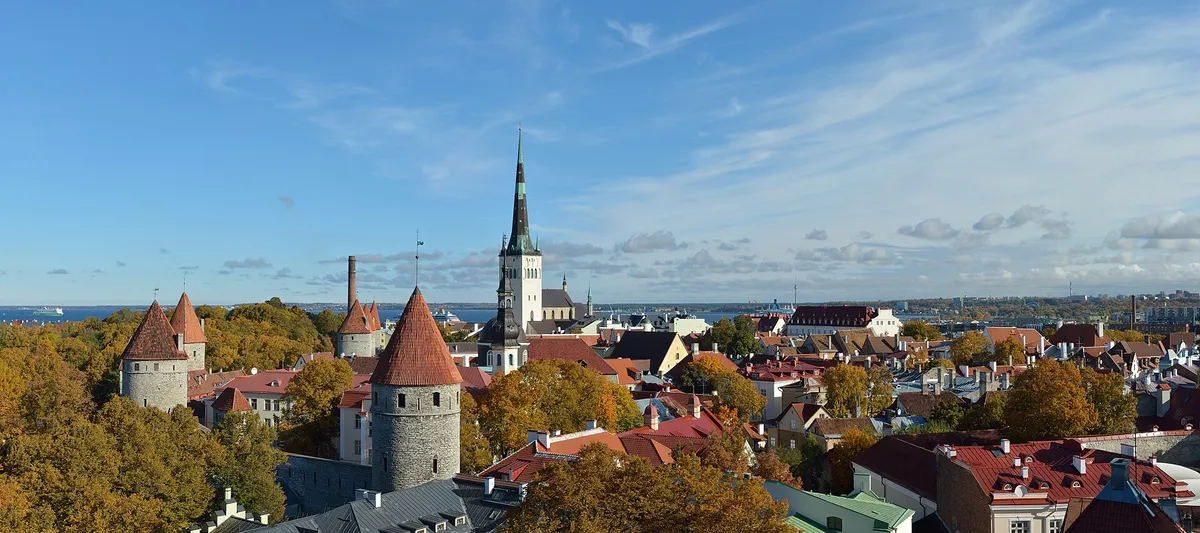
Photo: Ivar Leidus / Wikimedia Commons
Best Hotels in the Baltic States: Riga, Tallinn & Vilnius (2026)
Hotel Bergs Riga's 1879 Art Nouveau passageway suite, Three Sisters Hotel Tallinn's 15th-century medieval merchant house Old Town room, and Hotel Pacai Vilnius's 1677 Baroque palace UNESCO suite — Northern Europe's most architecturally layered Soviet-escape trio finest hotels in 2026.
The Baltic States: An Architecturally Surprising Trio
The Baltic States pack an unusual amount of architectural variety into three small countries. All three capitals — Tallinn, Riga, and Vilnius — have UNESCO World Heritage-listed Old Towns, a rare concentration for neighboring small-country capitals. Riga alone has around 800 Art Nouveau buildings, many designed by Mikhail Eisenstein (father of the film director Sergei Eisenstein), whose elaborate, sculptural facades make Riga’s streetscapes among the most photographed examples of Art Nouveau architecture anywhere.
The region’s modern history is defined by the Singing Revolution of 1987–1991, the peaceful independence movement that included the Baltic Way: on 23 August 1989, roughly 2 million people formed a 675km human chain running from Tallinn through Riga to Vilnius, one of the most striking demonstrations in the history of European independence movements.
The Baltic coast also produces roughly 80% of the world’s amber — fossilized tree resin as old as 44 million years, from an era famous for inspiring its use as a plot device in Jurassic Park.
The Baltic Hotels
Three Sisters Hotel Tallinn — 15th-Century Medieval Merchant House
Price: €200–1,200/night | Location: Pikk 71, Tallinn Old Town, Estonia
Three Sisters Hotel Tallinn occupies three 15th-century merchant townhouses in a city that was once Reval, one of the most important Hanseatic League trading posts in the north. The hotel’s medieval stone vaulted ceilings and preserved architecture sit inside Tallinn’s Old Town, one of the most completely preserved medieval city centers in Northern Europe, ringed by 26 surviving medieval towers.
Hotel Pacai Vilnius — 1677 Baroque Palace UNESCO Suite
Price: €300–1,500/night | Location: Didzioji 7, Vilnius Old Town, Lithuania
Hotel Pacai Vilnius occupies a 1677 Baroque palace built for the Pacas family, one of the most influential noble families in Lithuanian history — including Kristupas Zigmantas Pacas, a Grand Chancellor of Lithuania. Vilnius’s UNESCO-listed Old Town has one of the densest concentrations of Baroque architecture of any European World Heritage city, and the city’s historic Jewish community earned it the nickname “Jerusalem of Lithuania” (Vilna in Yiddish) — home to the Vilna Gaon, Elijah ben Solomon, one of the most important scholars in 18th-century Jewish intellectual history. The hotel’s restaurant serves modern Lithuanian cuisine, including cepelinai, the zeppelin-shaped potato dumplings filled with meat and cottage cheese that are the country’s best-known dish.
FAQ
When is the best time to visit the Baltic States? May–September covers the Baltic summer, including the long “white nights” of June and July, when daylight can stretch to 18–20 hours. Midsummer is celebrated as Jāņi in Latvia and Joninės in Lithuania on June 23 — a pre-Christian solstice holiday marked by bonfires and flower crowns that has endured alongside its Christian overlay. The Tallinn Christmas Market, one of the longest-running in Europe, takes over Raekoja Plats (Town Hall Square) each November and December. April–May and September–October are the shoulder months, with lower prices and fewer crowds.
What is the Baltic food scene like? Rye bread and smoked fish anchor Baltic cuisine. Latvian rupjmaize, a dense, dark rye bread, is recognized as a piece of Latvian intangible cultural heritage. Riga sprats — smoked and tinned, often sold as “Riga Gold” — are Latvia’s best-known preserved fish export. Riga Black Balsam, a 45% ABV herbal liqueur made from a 1752 recipe with 24 plant ingredients, was traditionally used as a medicinal tonic. And in Lithuania, the potato is central to the table — cepelinai is the most famous of roughly seven traditional potato-based dishes in Lithuanian home cooking.