
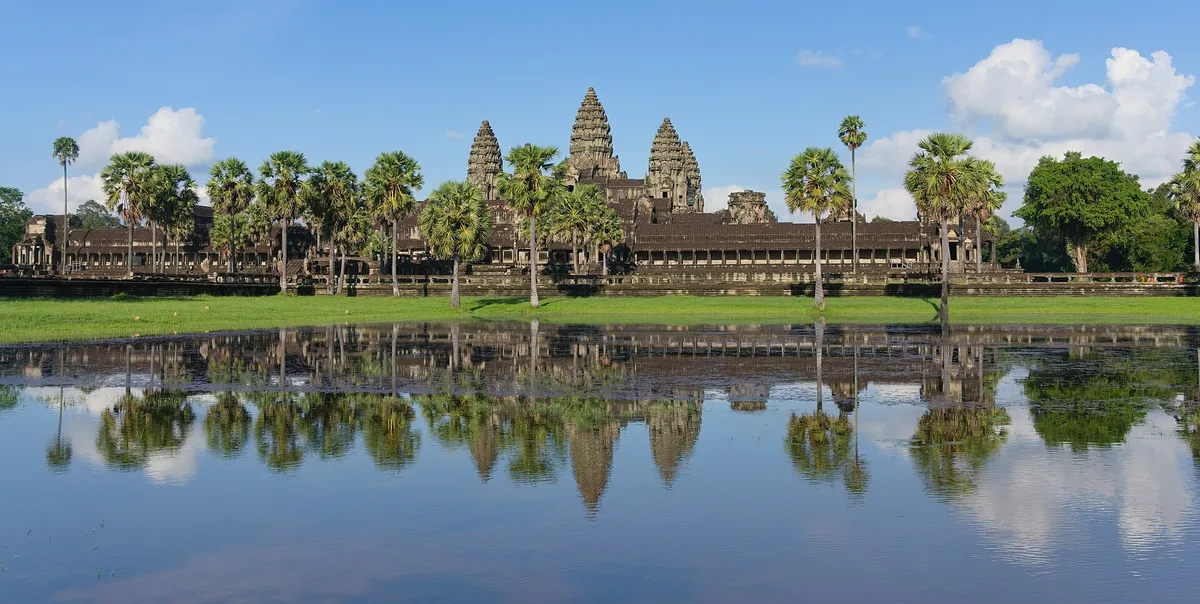
Photo: Satdeep Gill / Wikimedia Commons
Best Hotels Near Angkor Wat: Siem Reap's Finest Hotels and Resorts (2026)
Amansara's 24-suite poolside compound inside Angkor, the Phum Baitang Sofitel's rice field villa retreat, and the Park Hyatt Siem Reap's French colonial elegance — the best hotels for exploring Angkor Wat in 2026.
Siem Reap: The Angkor Experience
Siem Reap is the most historically resonant hotel destination in Southeast Asia — gateway to the Angkor Archaeological Park, a UNESCO World Heritage Site and one of the most important religious monument complexes in the world. Angkor Wat is the largest religious monument ever constructed, with a 1.6km moat, a 65m central tower, and an 800m bas-relief gallery depicting the Battle of Kurukshetra, the Churning of the Ocean of Milk, and scenes of Heaven and Hell. The Bayon features 54 towers carved with 216 faces of the Bodhisattva Lokesvara — the so-called “Angkor Smile,” one of the most recognizable images in Cambodia. Ta Prohm, the jungle temple, is famous for the giant strangler fig and silk-cotton trees growing through its stones, and for its role as a filming location in the 2001 Angelina Jolie film Tomb Raider, which did more for Cambodian tourism than almost any other single event.
The Best Siem Reap Hotels
Amansara — Inside the Angkor Complex
Price: $800–3,000/night | Location: Road to Angkor, Siem Reap
Amansara — one of Cambodia’s most celebrated hotels — occupies a 1962 building designed by Vann Molyvann, the most important Cambodian architect of the 20th century and creator of “New Khmer Architecture,” a style blending Khmer heritage with modernist principles. Originally built as a guest villa for King Sihanouk, the property hosted Jacqueline Kennedy during her famous 1967 Angkor visit. Amansara is one of the most intimate luxury hotels in Cambodia, with just 24 suites, including pool suites arranged around a courtyard that preserves Vann Molyvann’s original architecture.
Amansara’s private tuk-tuks provide a 5-minute drive to the Angkor Wat sunrise position — the 5:30 AM reflection of the central towers in the western pond is among the most photographed sunrises in the world. The hotel’s Angkor exclusivity program offers private after-hours access to restricted temple sections with a personal archaeologist guide, including areas of the conservation zones not open to regular tourists.
Phum Baitang — Rice Field Villas
Price: $300–1,500/night | Location: Omkum Road, Siem Reap
Phum Baitang (“Green Village” in Khmer) is a Sofitel-managed resort with 45 villas elevated on stilts above rice fields — one of the most visually distinctive resorts in Asia. The design draws on the traditional Cambodian phum village concept, the clustered family-compound layout of rural Cambodian settlements, with elevated wooden walkways connecting villas above the rice paddies and sunset views considered among the most atmospheric in Southeast Asia. The rice-field pool villas each have a private plunge pool overlooking the paddies. Phum Baitang’s Khmer cooking classes include a market tour with the resort’s chef and hands-on preparation of amok, Cambodia’s signature dish — steamed fish curry in a banana-leaf cup with coconut milk sauce and kaffir lime. The spa offers a dedicated Khmer treatment program.
Park Hyatt Siem Reap — French Colonial Elegance
Price: $200–1,000/night | Location: Sivatha Road, Siem Reap
Park Hyatt Siem Reap is a colonial-style hotel reflecting Siem Reap’s French Indochina heritage, set in the tree-lined French Quarter alongside French administrative buildings, the historic Grand Hotel d’Angkor (the 1929 colonial hotel where Somerset Maugham, Charles de Gaulle, and Jackie Kennedy all stayed during their Angkor visits), and Pub Street, Siem Reap’s backpacker-to-boutique dining strip. The hotel’s garden design includes a swimming pool, temple-inspired landscaping, and a restaurant terrace, making it one of the most accessible luxury options in Siem Reap.
Angkor Practical Guide
The Best Time for Each Temple
Angkor Wat: Sunrise (05:30–07:00) — the western reflecting pool is the prime photography position, capturing the silhouette of the 65m central tower against the pink sky.
Bayon: Morning (08:00–10:00) — the light brings out the detail on the 216 carved faces, among the most visually complex temple interiors in the world.
Ta Prohm: Morning (08:00–10:00), before the tour groups arrive — the jungle atmosphere is best appreciated in quiet, broken only by birdsong.
Banteay Srei: Midday — the pink ilmenite sandstone is best seen in full sun. The temple is the smallest major site in Angkor (roughly 1.0km in scale, compared to Angkor Wat’s 1.6km moat) but has some of the finest carved detail in the complex, including intricate apsara celestial nymph reliefs.
The Temple Pass
The Angkor Pass ($37 for 1 day, $62 for 3 days, $72 for 7 days) is the essential purchase for Angkor visitors. A 3-day pass is the recommended minimum: Day 1 covers the Angkor Wat sunrise, the Angkor Thom complex (Bayon, Baphuon, the Elephant Terrace), and Ta Prohm; Day 2 covers Banteay Srei (arguably the most beautiful individual temple in Angkor), Preah Khan (with its Hall of Dancers), and Neak Poan; Day 3 covers the outlying temples — the Roluos Group, the earliest Angkor-era temples dating to the 9th century, and Banteay Samré.
Cambodian Food Culture
Cambodian cuisine remains one of the most underrated in Southeast Asia. Lok lak — stir-fried beef in a lime-and-black-pepper sauce with an egg-yolk dipping sauce — is the most important Khmer dish after amok. Kuy teav, a pork-broth noodle soup with rice noodles, bean sprouts, and lime, is Cambodia’s most common breakfast. For the adventurous, the deep-fried tarantulas of Skuon (about 4cm across) are among the most challenging street foods available to a tourist in Asia.
FAQ
How many days for Angkor? Three days minimum for a comprehensive Angkor experience — a small circuit (Day 1: Angkor Wat and Angkor Thom), a large circuit (Day 2: outer temples), and the outlying temples (Day 3: Banteay Srei and Roluos). Five days allows time for the full experience, including Phnom Kulen — the sacred mountain with 1,000 Lingas carved into the riverbed — and Koh Ker, a remote 36m pyramid temple reachable by half-day excursion.
Is Siem Reap worth visiting beyond Angkor? Yes — Tonle Sap Lake is one of the most important freshwater ecosystems in Southeast Asia, home to floating villages that expand and contract with the seasons: the lake grows from about 2,500km² in the dry season to roughly 16,000km² in the wet season, one of the most dramatic seasonal changes of any lake in the world. Siem Reap town itself is worth exploring too — Pub Street, the Old Market (Psar Chas), and Artisans d’Angkor, an important craft education program supporting silk weaving, stone carving, and silversmithing among Cambodia’s artisanal communities.